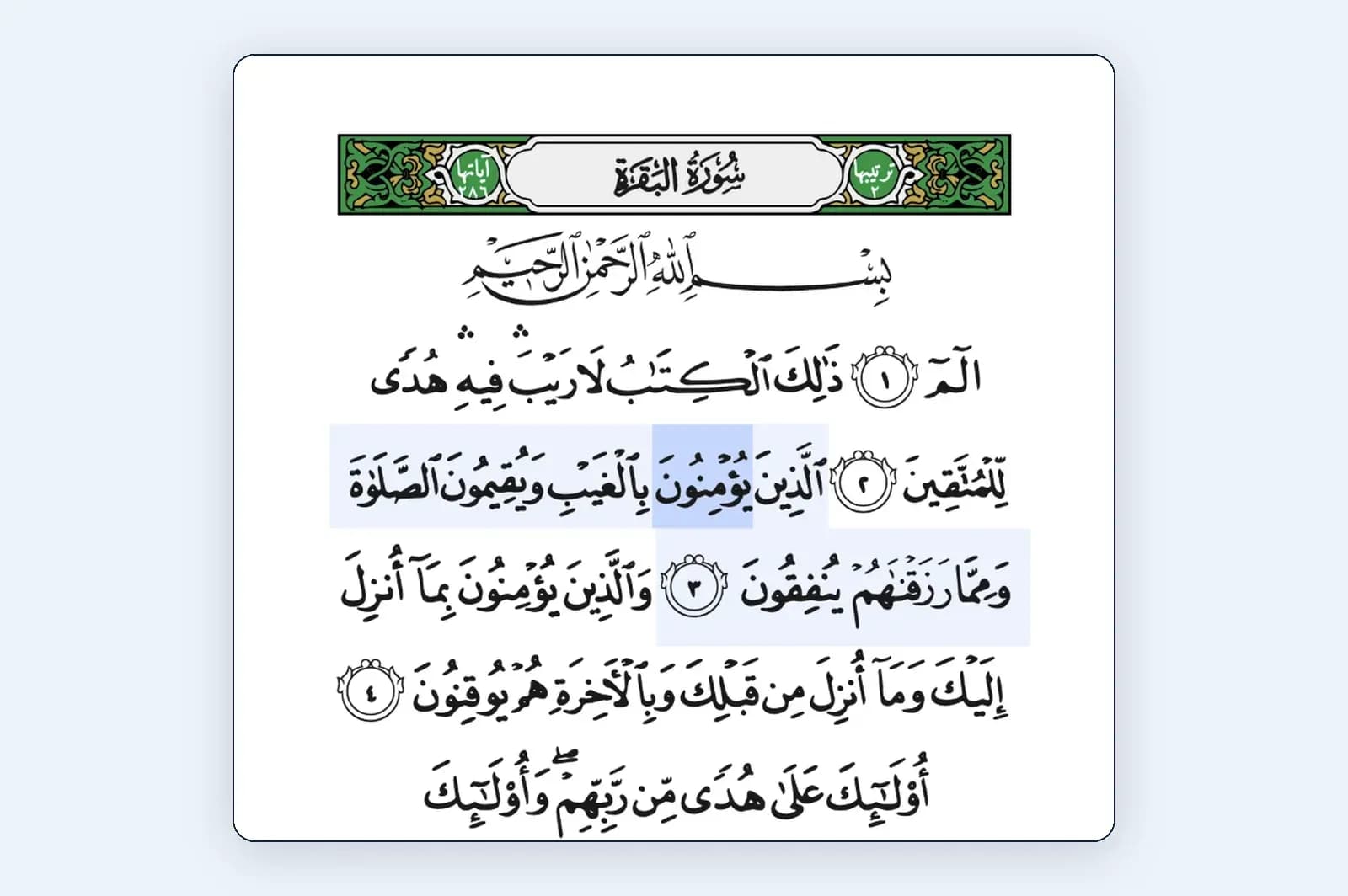
Murattal and mujawwad are labels you may encounter when choosing Quran recordings. The Smithsonian’s recitation discussion presents murattal as a relatively direct delivery and mujawwad as more melodically expressive. Begin with that distinction, then hear an actual recording before choosing it for your lesson. A style label gives you an opening question. Your next question is whether you can follow this passage and carry out the listening or practice you planned.
Understand the recording labels
Use those descriptions to guide attention when you listen. You might notice how a phrase unfolds, how much space surrounds it, and whether you can stay with the words. Keep your observations tied to the recording you heard, especially when two reciters with the same style label sound different to you. Give yourself an example to return to by saving its source and the precise passage.
When someone recommends a reciter, ask which recording they mean. Save the name, style label, source, and passage together. That makes a recommendation usable when a search brings up several versions. If you are preparing work for a teacher, show the actual selection and ask whether it fits the assignment. A familiar name can help you find a voice you enjoy, while the recording details help you recover the example you are studying.
Find a labeled example in Qiraa
Qiraa gives you a place to begin that comparison. Its official listening guide documents style labels and audio samples in the reciter selector, plus passage ranges, repeats, and pauses in playback. Inspect the label on the selection you open and listen to its sample. Then choose a short passage you already know how to locate. The listening screen pictured in this article’s cover shows the app’s playback view.
Compare the same passage
For a small comparison, use the same passage in two recordings whose style labels you can confirm. Where available, two styles from the same reciter let you keep the voice familiar. Two different reciters can also make a useful comparison if you record both names. In either case, choose the examples you can actually recover and replay. Begin at the recording’s normal playback setting so your observations refer to the selected performance.
Start with the first recording and follow the text through once. Notice one feature you can describe in ordinary words. Perhaps you can locate every phrase easily, or perhaps you lose the text when the delivery becomes less familiar to you. Write the place where that happens. Keep the observation small enough to check on a second listen. “I lost my place at this phrase” gives you something more specific to investigate than a general judgment about the style.
Now play the same passage in the second recording. Listen for the feature you chose, and notice how the passage feels to follow. You might hear a different shape to a phrase or a different amount of space between phrases. Return to the written reference if you become unsure where you are. A comparison is useful when you can describe the examples you heard and explain what you would use each one to do.
Choose for reading practice or attentive listening
- Select one short passage and confirm it in both recordings.
- Record each reciter’s name and the style label supplied by the source.
- Hear the first example while following the text, then note one observation.
- Hear the same passage in the second example and revisit that observation.
- Choose the recording for your present task and keep the exact reference.
For learning to read back a passage, choose the example you can follow and attempt comfortably with your teacher’s guidance. Hear a short part, then make your own attempt after it ends. Ask the teacher to hear the reading and clarify any uncertainty about articulation, length, or pauses. Keep the instruction attached to the passage. Your preference for a recording and the feedback on your reading can both inform what you practise next.
A separate listening session can have a different purpose. You may want to stay with an expressive rendering of a passage and notice its movement over a longer stretch. Give that session enough uninterrupted attention to follow the text at its own pace. Afterwards, write one observation about what helped you remain with the passage. You can appreciate a recording for that experience and choose another example for a short reading exercise.
Use another listen to answer one question
Repeat the comparison only where it answers a real question. If you are unsure whether a phrase is easier to follow on the first or second listen, return to that phrase in both recordings. If the uncertainty concerns the Arabic itself, prepare the exact place for your next lesson. Our word, ayah, and full-surah audio guide can help you choose the size of the listening selection.
For a broader listening example, the Smithsonian program above presents several named styles. Its program lists different passages for the murattal and mujawwad sections. Check those references before treating it as a comparison of identical text. You can use the event to hear its labeled examples, then build your own same-passage comparison separately. Keep the title and passage alongside any note so that you can return to the example that prompted it.
Keep the chosen recording with the task
Once you choose a recording for an assignment, give yourself time to work with it. When a different style interests you, explore it in a separate listening session and return deliberately to the example selected for your current task. The Qiraa listening-settings guide explains how to give playback choices a clear purpose. Here, the first decision is the recording and the kind of attention you want to bring to it.
You can finish with a straightforward choice. For today’s passage, which recording helps you do the work you planned, and what remains for your teacher to hear? Keep the name and style label with that answer. Try a second example later if you have a new question. Understanding murattal and mujawwad becomes practical when the terms help you find, hear, and return to a recording you can use.
Smithsonian National Museum of Asian Art recitation demonstration


Responses
A thoughtful conversation starts with care. Responses are reviewed before they appear.
Loading the conversation…