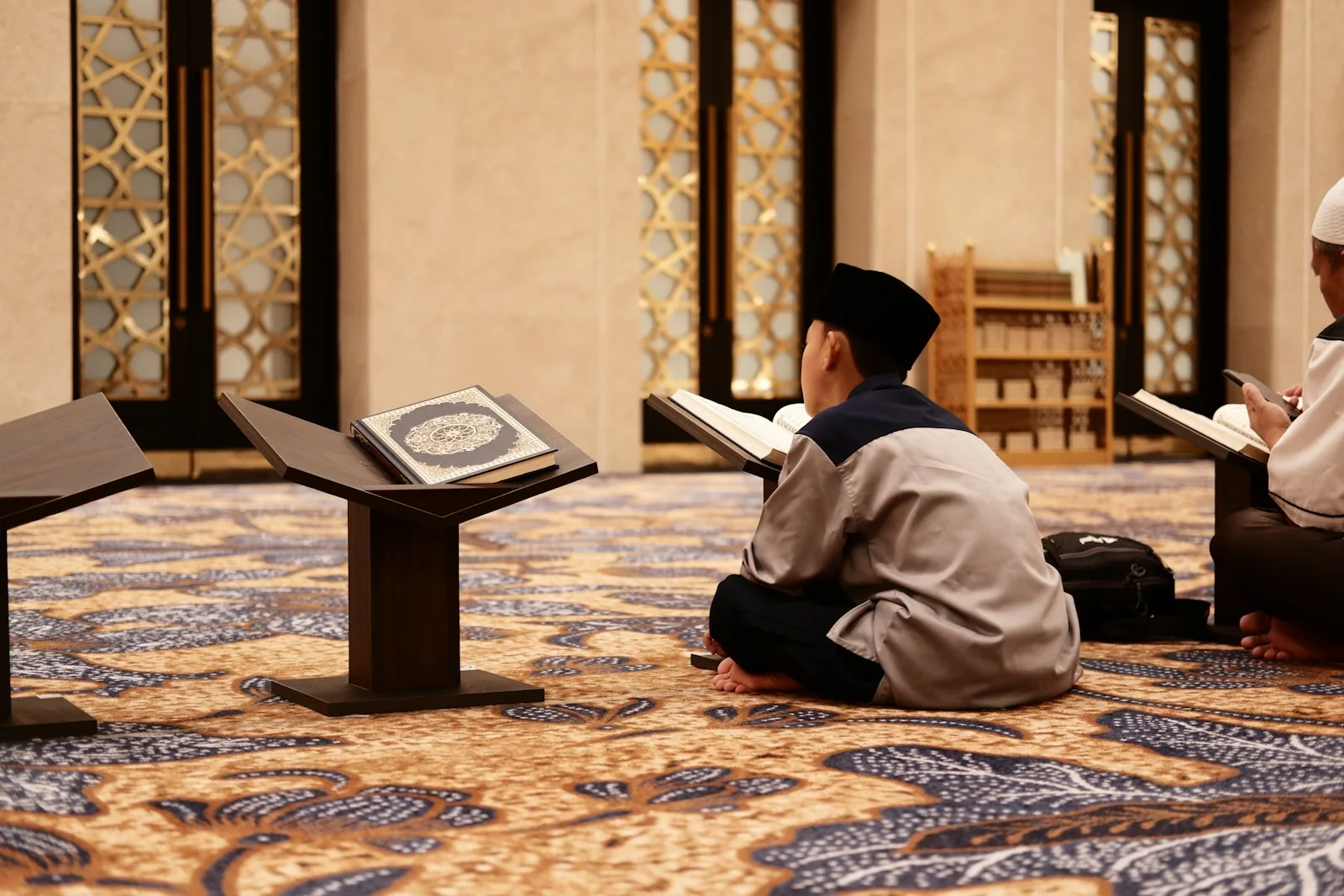
A source-led reading exercise from Quran Blog. Passage details were checked against the Arabic and Dr. Mustafa Khattab’s The Clear Quran on 19 October 2026. Study activities are editorial suggestions, not an independent tafsir or religious ruling.
A map can make a distant place feel immediately knowable. A pin appears, a route joins two points and a caption tells you what happened there. When using maps for Quran study, pause before accepting that sense of certainty. A place named in an ayah, a historical identification and a modern coordinate are different kinds of information.
This exercise begins with three references: Badr in 3:123, Hunayn in 9:25 and Mecca in 48:24. It does not attempt to identify every Quranic place or establish ancient site boundaries. We use these locations to practise reading sources, with The Clear Quran by Dr. Mustafa Khattab as the named English translation.
Make the source card before the map
Make a source card for each reference before opening a mapping service. Give it four fields: wording in the Arabic, wording in the translation, explanatory addition and geographical question. If you are not yet able to identify the Arabic name, ask a teacher or use a reliable word-level resource. Leave the field open until you can check it.
Keep the place attached to its ayah
At 3:123, locate Badr in the ayah and read the surrounding passage. The translation refers to Allah’s help and the believers’ circumstances. A map might help you form a question about setting, but it cannot supply the passage’s meaning by itself. Begin with what the verse says, rather than making geography the main claim before you have read it.
On your card, write the reference and the place name as your chosen source presents it. Different English spellings may appear in different books. Preserve the spelling from the source you are using, and note alternatives when they matter for searching. A difference in transliteration is a reason to check an identification, not automatic evidence for a different location.
Move to 9:25 and identify Hunayn. Read through the nearby ayahs rather than extracting the name from a search result. The selected ayah describes a situation in which great numbers did not bring the expected advantage. Keep that immediate wording beside the name so that the card remains connected to a passage instead of becoming only a travel label.
Notice a translator’s clarification
Next, look closely at 48:24. The Arabic names Mecca. In The Clear Quran’s rendering, explanatory brackets introduce Hudaibiyah in the phrase about the valley near Mecca. That visible distinction gives you a practical source-reading lesson: a clarification in a translation should be recorded as a clarification, rather than silently copied into a claim about the exact words of the Arabic.
If you use another translation, inspect its wording and notes separately. It may make the location clearer in a different way or leave an explanation to a footnote. Keep the translator’s name attached to your observation. Do not merge several translations into one unattributed sentence and then say that the Quran states every detail in your combined version.
Your cards now separate three questions: what is explicitly named, what is explained by the translation, and what you still want to know geographically. You can research the last question using suitable historical and geographical scholarship. The first two questions do not vanish when you open a map; they remain the foundation of your source trail.
Ask what a modern pin represents
When evaluating a modern map, look for an identifiable author or institution, a publication date, a legend and sources. Ask whether a pin represents a present-day settlement, an archaeological site, a traditional identification or a broad area. If the map does not explain this, avoid presenting its precision as though it were established historical evidence.
Distances require the same care. A straight line on a screen, a modern road route and a reconstructed historical journey answer different questions. This guide supplies no coordinates or route lengths. If your study needs them, record the method and source for each figure instead of assuming that a modern navigation result describes movement in an earlier period.
A useful visual can therefore be deliberately simple. Place the three names on separate cards and connect each to its ayah reference, without drawing a route between them. Add a question mark where further research is needed. Such a diagram can be more honest and more helpful than an impressive map whose unsupported details you cannot explain.
Compare the evidence together
For a group activity, give each participant one source card and ask them to identify what their verse actually supplies. Then compare the cards before viewing any maps. This order lets the text shape the questions. It also gives beginners a concrete task: finding a name and a reference is a valid contribution without requiring a lecture on historical geography.
If someone brings a site photograph, ask what its caption establishes. A photograph may show a present-day monument, sign or landscape, but it does not automatically prove that a particular event occurred at the exact camera position. Keep the photographer’s identification, the historical claim and the Quran reference separate in the discussion.
Write captions that preserve uncertainty
Before sharing your work, check every caption. A careful caption can say that an ayah names a place, then identify a separate source for the modern location or historical explanation. Keep uncertainty words such as proposed or traditionally identified when the source uses them. Removing a qualification may make a caption shorter while making it less accurate.
Return to the three ayahs after the map exercise. Can you still describe their wording and context, or do you now remember only the pins? A study map has served you well when it helps you ask a better question and return to the text. It should leave you clearer about what is known, what is supplied by explanation and what still needs research.
Read Al-Fath 48:24 — The comparison also uses Ali Imran 3:123 and At-Tawbah 9:25, linked in the article. No modern coordinates, site identifications or travel distances are asserted by this guide.
Responses
A thoughtful conversation starts with care. Responses are reviewed before they appear.
Loading the conversation…