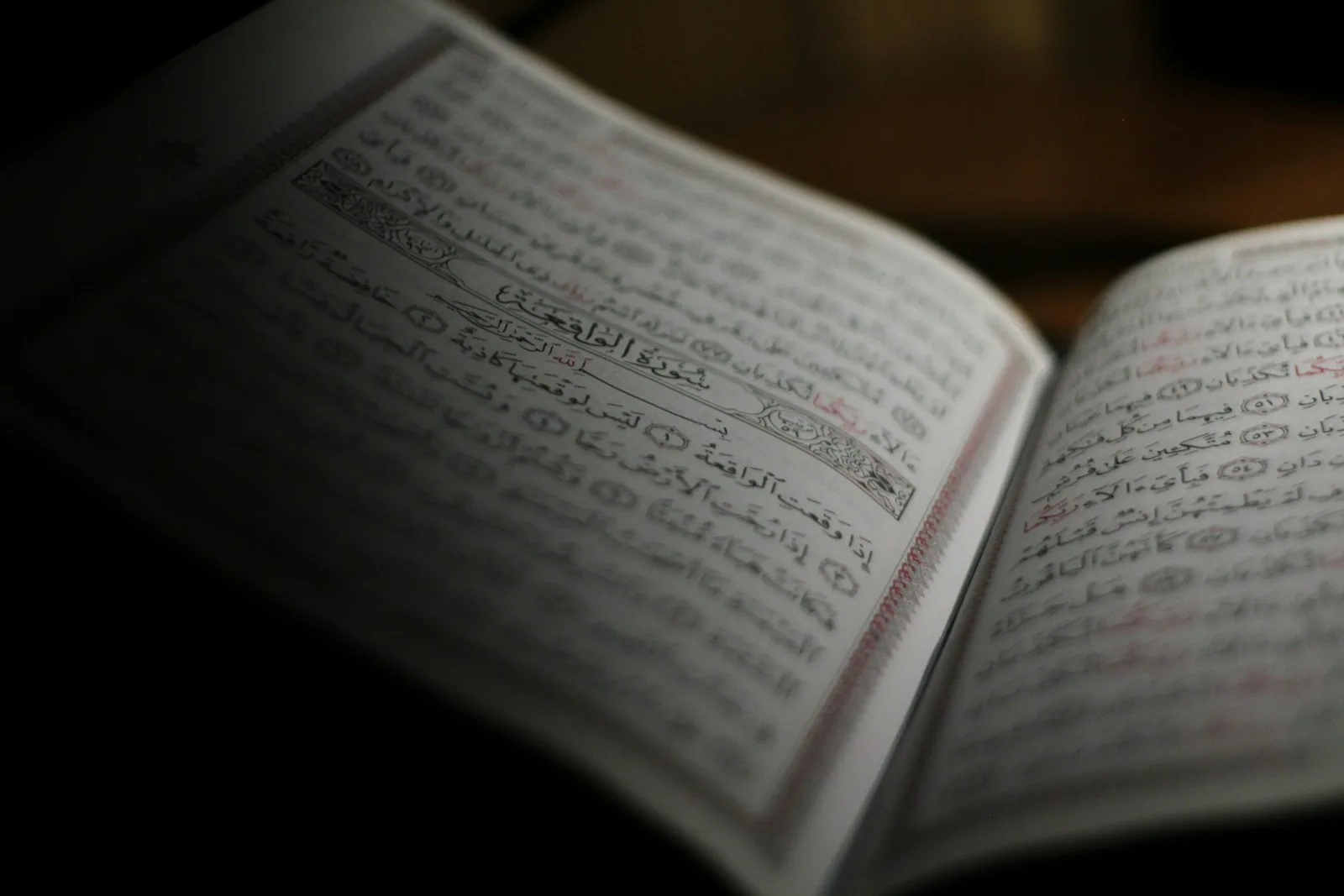
A source-led reading exercise from Quran Blog. Passage details were checked against the Arabic and Dr. Mustafa Khattab’s The Clear Quran on 19 October 2026. Study activities are editorial suggestions, not an independent tafsir or religious ruling.
When a line returns again and again, it can become the part you hear most clearly and examine least closely. In Surah Ar-Rahman, the repeated question is familiar to many listeners. A useful reading begins by asking what stands immediately before each return, and whether you have been listening to those surrounding ayahs with the same attention.
This exercise follows selected parts of Surah Ar-Rahman, with the complete surah kept available throughout. It uses the Arabic and The Clear Quran by Dr. Mustafa Khattab. We are proposing a method of reading and listening, rather than claiming that a few notebook labels explain the full structure or interpretation of the chapter.
Keep the question attached to a passage
Begin by reading from the opening through the first occurrence at 55:13. In The Clear Quran, the repeated question is rendered, “Then which of your Lord’s favours will you ˹humans and jinn˺ both deny?” Keep the translator’s name with this wording. When reading another language, record that translation’s own phrasing rather than treating this English sentence as the Arabic text.
Make a page with three small fields: reference, preceding subject, question for further study. Use your own brief label for the second field and mark it as a label. A summary such as “created world” can help navigation, but it will inevitably omit details. It should send you back to the passage, not replace the passage in discussion.
Compare different surroundings
For your first comparison, read 55:1–13 in full, continuing in the interface until verse 13 is visible. Notice the opening references to teaching, creation, measured order and earthly provision. Choose one detail you can locate precisely. Write its reference before moving to the refrain, so that the connection you are considering remains checkable.
Now move to 55:26–30. These ayahs bring mortality, the Lord’s permanence and dependence into view around returns of the question. Read the actual wording rather than relying on those topic labels. Ask what changed in your attention when the same familiar question followed a different passage.
For another comparison, read 55:41–45. The surrounding subject includes judgment and punishment. Do not quietly omit this section because it does not fit a comforting image you have attached to the surah. A careful reading makes room for the parts that challenge your first description, while leaving interpretive questions for suitable explanation.
Then read a manageable portion beginning at 55:46 and continue towards the closing ayahs. Note the references to gardens and the repeated question within that setting. You do not need to catalogue every object or produce a complete outline in one sitting. Pick a passage small enough to read properly and write down where you stopped.
Ask what your comparison can establish
Your comparison now has several locations rather than one isolated line. Ask a limited question: what is the immediate subject at each location? A more ambitious question about the theological or literary relationship between all these returns needs an identified commentary. Keep that question on the page instead of supplying a confident answer because your chart looks persuasive.
Listen for the lead-in
Listening can follow the same pattern. Choose a clearly identified recitation and follow the ayah numbers. Listen to the passage before the refrain, then read that section silently. If you replay, include enough of the surrounding text to preserve the connection you are studying. The musical familiarity of the return should not draw all your attention away from its setting.
Do not turn this into an exercise in imitating the reciter’s voice. A learner may need help with pronunciation, breath and appropriate stopping. Those questions belong with a qualified teacher who can hear the learner. This exercise concerns attention to the sequence of the text; it cannot tell whether a particular recitation technique is correct.
If you are studying with a friend, choose two locations and let each person describe the preceding passage in one sentence. Reopen the ayahs to check both sentences. Ask what each summary leaves out. This is often more revealing than asking for a sweeping explanation of why the refrain repeats, especially when neither participant has consulted a commentary.
Save questions that need explanation
The word “both” in the English rendering may prompt a question about the addressed audience. Record that question and consult a named tafsir rather than treating an English pronoun as enough evidence for a full explanation. A good note preserves the distinction between something the translation makes you notice and an answer supported by further study.
Keep personal reflection in a separate area. You might write that the movement from provision to mortality changed the way you heard the question. That is an account of your response, not a claim that you have discovered the only purpose of the repetition. Give another reader room to ask about a different passage without forcing their attention into your experience.
Revisit one return with greater attention
At the next reading, choose one return you previously passed quickly. Read the ayahs around it and update your note. If a commentary answers your question, record the author and relevant location. If it complicates your outline, keep the complication. A useful reading map is allowed to become more accurate and less tidy.
Finish by returning to the opening and reading as much of the surah as you can attend to well. The refrain may sound as familiar as before. What you now bring to it is a set of nearby references, a clearer sense of the sequence and a willingness to hear the words that lead into each return.
Read Surah Ar-Rahman — The short quotation at 55:13 is from Dr. Mustafa Khattab’s The Clear Quran. Other verse descriptions are paraphrases. The reading map is an editorial activity, not a complete surah commentary.
Responses
A thoughtful conversation starts with care. Responses are reviewed before they appear.
Loading the conversation…