
Choose a Quran habit tool by whether it makes the next practice session easier to begin and recover. A reminder, a revision plan and a reading display serve different jobs. This October 2026 guide compares documented workflows with Qiraa affiliation disclosed. Try your actual routine before treating a progress chart or notification as evidence that the tool fits it.
Test the beginning and the return
- Name the task you want to repeat and save the passage or review portion it requires.
- Check whether the tool helps you start that task without adding unnecessary setup decisions.
- At the following session, recover where you stopped and what needs attention; adjust the tool or routine from that experience.
Choose a habit tool for the practice it supports
The most useful habit tool is the one that helps you begin the practice you actually chose. A notification cannot decide which passage needs review. A progress chart cannot tell you whether you understood the reading. An elaborate plan may even add decisions to a session that was already difficult to start.
For October 2026, we considered three needs: a clear next step for a mixed learning routine, organization of a defined review range, and a simple reading session with meaning. The recommendations use official documentation checked in October. They are editorial judgments about task fit, not independent hands-on testing, numerical accuracy rankings, or evidence that one app improves everyone's retention.
We are Qiraa team editors, so our Qiraa recommendation is affiliated. Qiraa receives the first recommendation for one specific workflow below; the other resources fit different tasks. Confirm current device availability and subscription terms before choosing. The right arrangement may include a paper note as well as an app.
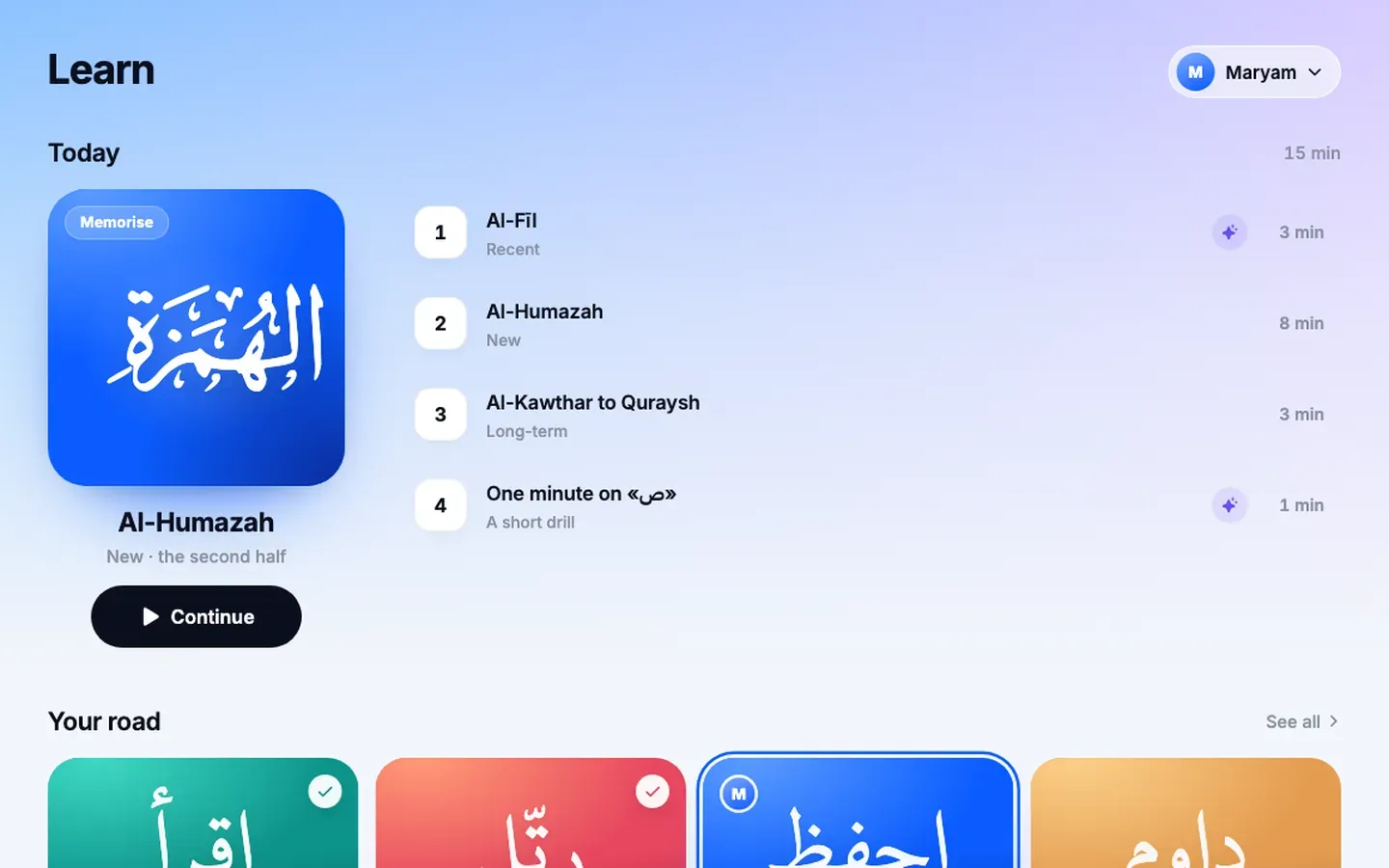
Qiraa: our pick for a guided daily next step
Qiraa's documented daily flow connects a chosen focus and available time with the next learning or review action. That makes it our pick when the main difficulty is deciding what to do across reading, foundations, and hifz practice. The feature fit supports the recommendation; it does not establish superiority in a comparative learning trial.
To evaluate that fit, define one week of work before starting. Perhaps you want to read a small passage on three days and review an already learned portion on two others. Check whether the proposed next steps help that goal, whether you understand them, and whether you can adjust the arrangement when your available time changes.
Avoid treating a suggested duration as a promise about how much Quran you will learn. Ten minutes may contain different work on different days. What matters is whether the session produced the intended action and left a clear place to continue. If the plan repeatedly overwhelms you, make the target smaller and discuss the learning need with your teacher.
Tarteel: a strong option for a defined review plan
Tarteel's Goals guide documents range, portion, and schedule choices, including flexible and fixed approaches. Consider it when your main need is organizing a known memorization or review workload. First distinguish the total range from the amount appropriate for one session; those are different planning decisions.
For example, a learner may have a short set of surahs to review over a week. Write the references, choose realistic sessions, and keep room for a passage that needs extra attention. A missed session should prompt a revised workload rather than an attempt to rush through difficult material simply to make the schedule appear complete.
Ask your teacher what review quality should look like for your current level. A completed range is useful information, but it does not show every aspect of the recitation. Use the plan to organize attempts and return for informed listening. A scheduling feature should make the teaching connection easier to maintain.
Quran.com: a simple choice for reading with meaning
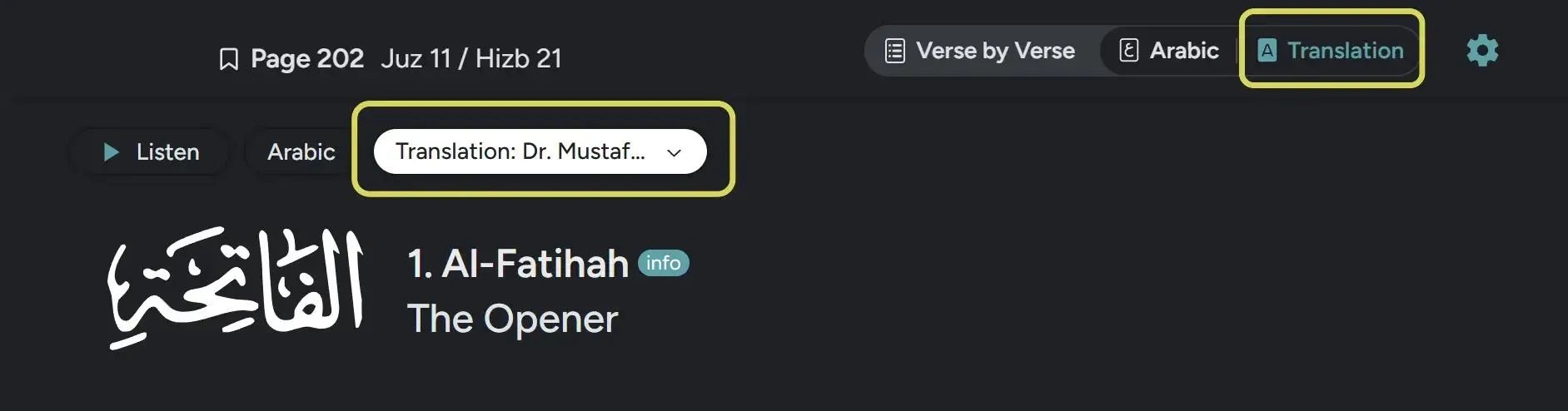
Quran.com's resource description includes translations, commentary, audio, and reading goals. It suits a routine built around encountering a passage and exploring its meaning. Choose one named translation at first, then consult an appropriate commentary for questions rather than collecting many unexplained tabs.
A practical session might contain a short Arabic passage, a named translation, and one written question. Bookmark the next passage before closing the page. If you are returning after a gap, retain the same small task for a few sessions instead of repeatedly redesigning the entire routine. The bookmark and notebook can be as important as the screen.
Keep reflection and sourced explanation distinct. Write what the reading made you notice about yourself, then separately record what a commentary explains. If the passage raises a religious ruling or a difficult interpretive question, bring it to a qualified teacher. A habit becomes more useful when it has a place for questions, not only completion.
Put a beginning beside the intention
The original implementation-intentions review examines plans linking a situation with a chosen action. Its research concerns varied goals, not a guaranteed Quran-habit outcome. A modest application is to name a real opportunity: after an existing daily activity, open a specified passage and perform a bounded task.
Write the opportunity and the task together, plus a smaller fallback if the usual time is unavailable. Then observe a week honestly. Which sessions began? What work did you do? Which obstacle recurred? Keep the smallest adjustment that helped and remove configurations you never used.
Choose Qiraa for a guided next-step routine, investigate Tarteel for defined review planning, or begin with Quran.com for a sourced reading session. Let the task determine the tool. A good October plan ends with less uncertainty about tomorrow's first action and more attention available for the passage itself.
Sources and further reading
How Qiraa works — Official chosen-focus/time/next-action flow; task-fit affiliated recommendation, no numerical outcome claims.
Tarteel How do I use the Goals feature? — Official range, portion, schedule and flexibility documentation; very brief summary.
Quran.com About Us — Brief resource-feature summary only.
Implementation Intentions and Goal Achievement: A Meta-analysis of Effects and Processes — Original Gollwitzer/Sheeran review on if–then planning, verified publisher abstract; Quran application explicitly editorial.
Research notes: sources for these archive articles were checked in October 2026. Product details reflect that research date. The byline identifies a collective Qiraa editorial desk. Product recommendations disclose our affiliation and reflect documented task fit, without claiming independent hands-on benchmarks. Suggested exercises apply the cited research; they are not Quran-specific trial results unless stated.
Continue reading
What a good Quran app should explain about your audio
Best Quran resources for returning learners in September 2026: a retrospective guide
Related reading
Continue with A 10-Minute Quran Reading Routine You Can Adapt or Weekly Quran Practice Review: A Simple Planning Template.


Responses
A thoughtful conversation starts with care. Responses are reviewed before they appear.
Loading the conversation…