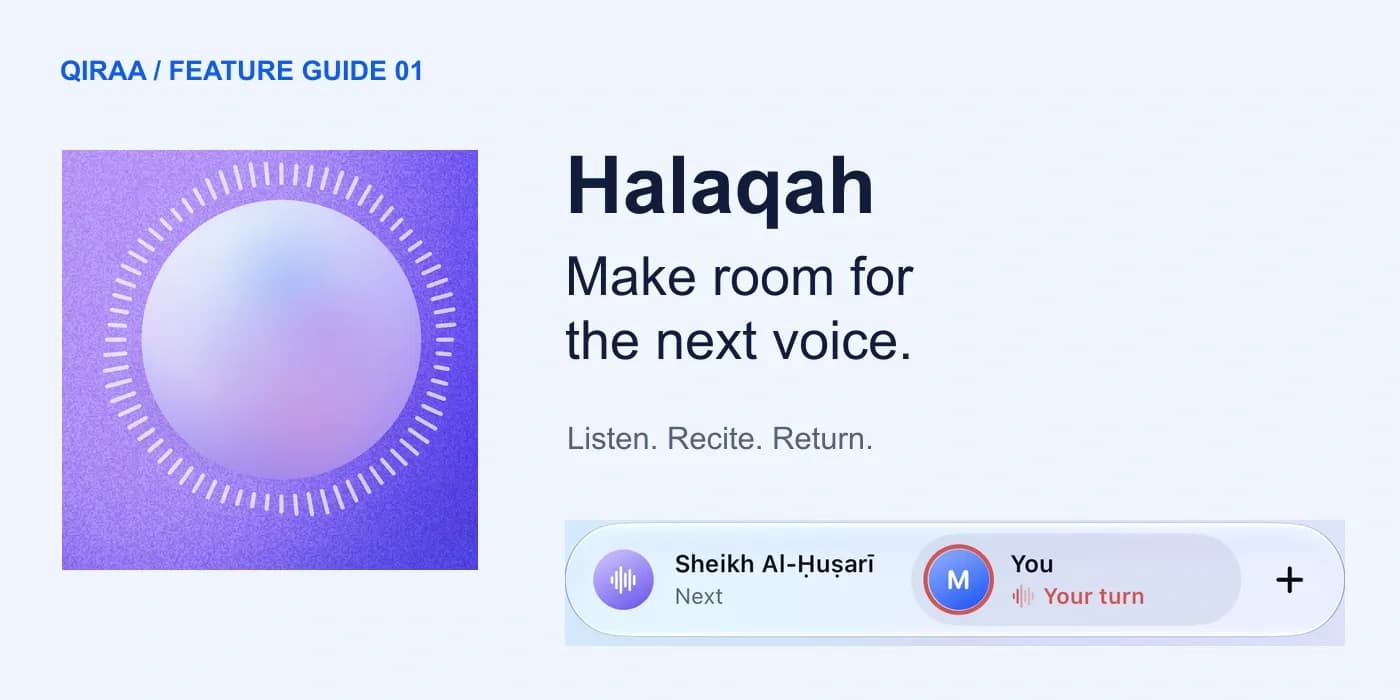
A Quran halaqah gives a shared reading session a clear passage, turns and attentive listeners. Qiraa's illustrated iPhone guide describes a same-device sitting with a recorded qari and people beside you, with reading or hidden-word practice and a review of places needing help. This article is from the team behind Qiraa; the session plan is editorial guidance, and uncertain recitation still needs qualified feedback.
Prepare a useful first sitting
- Agree on a manageable passage and whether the task is reading, listening or recall practice.
- Check the participants' turns and text support before beginning; the documented group uses the same device.
- After the sitting, choose one checked reference to revisit and take unclear recitation feedback to a qualified teacher.
Give the shared reading a clear purpose
An original editorial guide from the team behind Qiraa and Quran Blog. Product details follow Qiraa’s published iPhone guide, checked on 11 October 2026. The practice plan is an editorial suggestion. The cover combines Qiraa interface details in an editorial illustration.
Someone finishes an ayah. The person beside them takes a breath and begins the next. A listener follows the words, notices a hesitation, and waits long enough for the reader to find their place. A Quran halaqah can begin with a moment as ordinary as that: people making time to read, listen and learn together.
You do not need a large group to start. Two friends, siblings or a parent and child can make a small reading circle. What gives the sitting its shape is a shared passage and a clear invitation for each person to take part. Everyone should leave knowing what they practised and where they will begin next time.
Qiraa’s Halaqah feature helps organise that sitting. It puts the chosen passage, the people’s turns and a recorded qāriʾ in one place. This article looks at the learning habits a circle can support, then offers a simple way to try them. The illustrated Qiraa guide provides the detailed controls and screenshots.
What makes a Quran halaqah useful?
In this article, a halaqah means a small Quran learning circle whose members read or recite and attend to one another’s attempts. The gathering might include a teacher, or it might be a practice session between lessons. Agree on which kind of sitting you are having so that everyone understands who can answer questions and which questions need to go back to a teacher.
Gathering to read and study the Quran has a place in the Islamic tradition. Sahih Muslim 2699a, narrated from Abu Huraira, describes people assembling in a house of Allah to recite and study the Book, and speaks of tranquillity and mercy accompanying that gathering. Its description brings reading and learning from one another into the same gathering.
For a small practice circle, give that care a practical form. Make space for an unfinished attempt. Keep the text within reach. Agree that a request for help is welcome. A learner should be able to say, “I need to hear that again,” without feeling that they have delayed everyone else.
Learn through listening, turns and recall
When someone else reads, you have a useful job: follow the same passage closely. If you lose the place, recover it before trying to correct anything. Notice one point you want to revisit, such as the connection between two ayahs. A question with a verse reference gives the group something concrete to work on.
Taking a turn changes your task. You now have to produce the words yourself. A passage can feel familiar while another voice carries it, yet become uncertain when it is your turn. Give each person their own attempt so the group can see where more preparation, a prompt or a teacher’s explanation would help.
There is relevant learning research, although it concerns different material. In Smith and colleagues’ 2009 study, discussion improved understanding of conceptual questions in an undergraduate genetics course. The practical lesson to consider is that a group can do more than pass an answer around: members can ask what they understood and examine their reasons together. That finding does not establish a particular improvement in Quran recitation.
For memorisation, include an attempt that asks the learner to recall rather than follow visible text. Karpicke and Roediger’s 2008 vocabulary experiment found benefits for delayed recall from continued retrieval practice after an item had first been learned. In a halaqah, a reasonable application is to revisit a manageable passage from memory, then check it. This is a practice suggestion, not a measured outcome for Qiraa.
A circle also gives a practice plan a place in the week. Before leaving, agree on one passage and the next sitting. Keep the commitment small enough that everyone can prepare. Someone who needs more time should know how to join the next session, rather than having to guess whether the group has moved beyond them.
How Qiraa makes the shared sitting work
Qiraa’s published guide describes a circle on one shared device: you, up to two people beside you, and the recorded qāriʾ. Choose a surah or a shorter ayah range, a juzʼ, or a page. A family can therefore sit around the same passage while the app keeps the reading place visible.
The turn options are Āyah each, Page each and Together. Short turns give more frequent handovers; a page gives a reader a longer stretch. Together gives the human participants a shared turn, while an included qāriʾ keeps separate turns. Choose the pattern for the work you want to do today.
Qiraa allows word visibility to be chosen for each participant. One learner can read with the words shown while another practises recall with them hidden. The active passage is highlighted as the sitting progresses. These controls help a mixed group share a session without requiring everyone to use the same amount of text support.
Gentle, Coach and Strict change the response to a slip. Review can show marked wording and what the app heard; a word peek is recorded as help used. Use those details to choose the next practice. For exact steps, follow the Halaqah walkthrough, whose examples use the iPhone interface.
A simple plan for your first sitting
Before you press Begin, ask each person what would make their turn manageable. A newcomer might prefer a short passage with the text visible. Someone revising might want to hide the words. Someone tired might want a smaller portion today. An appropriate starting point makes participation more useful than giving everybody an identical challenge.
The plan below is an editorial suggestion for a first sitting of about ten minutes. Adjust the time to the people present. Choose material you already know enough to attempt, and give yourself room to learn the controls. If a teacher has assigned a passage or practice method, start with that assignment.
- Choose one short passage and name the purpose: reading from the text, revising from memory, or working on a known difficulty.
- Agree on the participants and turn order. Let each learner choose the text support they need before starting.
- Take the first pass slowly. On listening turns, follow the passage; on reciting turns, give the learner space to attempt it.
- Pause to check one place that needed help. Hear the reference, try the phrase again, and reconnect it to the neighbouring ayahs.
- End by saving one next step for each person and agreeing when you will sit together again.
After the first pass, check that everyone actually practised the material you intended. Alternating ayahs means each person recites only their assigned verses during that pass. Change the starting order or make another suitable pass when each learner needs to practise the rest. Listening and reciting are both useful activities; keep a clear record of which one each person did.
Make feedback safe to use
A smooth sitting gives each voice room to finish. Agree beforehand whether a listener should offer a prompt immediately or wait for the learner to ask. Keep feedback brief and specific: identify the place, check the wording together, and invite another attempt. Leave time for the learner to use the feedback while the passage is still in front of them.
If two people disagree about a pronunciation or stopping point, save the reference and ask a qualified teacher. Qiraa can help organise attempts and draw attention to wording that needs checking. A teacher can hear how you form sounds, explain a recitation rule and choose the next correction for your level. Bring a precise question to that lesson.
Treat an automated result as information about the attempt the app checked. Look at the marked words and compare them with what you intended to say. If the microphone did not capture you clearly, pause and make a clearer attempt. A percentage by itself gives the group much less to discuss than a specific word, phrase or transition.
Leave with one clear next practice
Before closing the sitting, each person can choose one place to return to. Record the surah and ayah, what happened, and the next action. For example: “I needed a prompt at the start; next time I will try that ayah without it.” That note belongs to the learner’s own attempt, rather than becoming a comparison with someone else’s pace.
Revisit the difficult place with the surrounding passage as well. Getting one word right on its own leaves the connection into and out of it to practise. Our guide to fixing an ayah you keep forgetting offers a focused way to work on a recurring slip. For questions that need teaching, use the teacher feedback guide to prepare your next lesson.
A useful halaqah leaves something modest and clear behind: someone had a chance to recite, someone listened carefully, and a difficult place became easier to identify. Begin with a passage you can return to and people willing to give one another attention. Qiraa supplies the shared passage and the handovers; the patience and care of the circle come from you.
Qiraa’s illustrated Halaqah guide — Product details and interface examples checked on 11 October 2026. Research references are linked beside the relevant claims. This article is from the team behind Qiraa and Quran Blog.
Related reading
Continue with How to Organise a Quran Reading Circle with a Clear Purpose or How to Use Your Quran Teacher's Feedback Between Lessons.

Responses
A thoughtful conversation starts with care. Responses are reviewed before they appear.
Loading the conversation…