
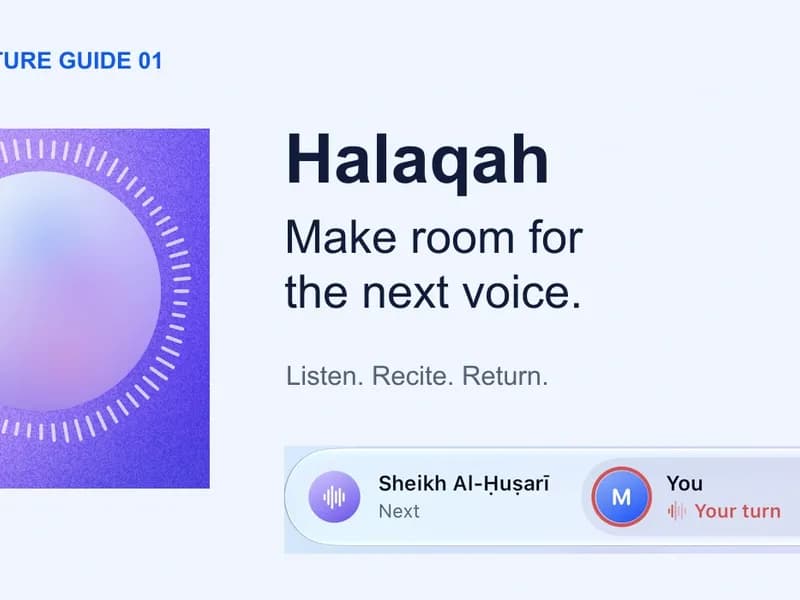
To organise a Quran reading circle, agree on the purpose before choosing the format. Recitation practice, translation discussion and study of a named tafsir need different preparation. Select a passage, share the source and decide how to record questions that remain unresolved. A clear agenda makes space for participation without requiring the group to answer beyond its knowledge.
Send a simple meeting outline
- Purpose and preparation: name the passage, source and kind of participation the session invites.
- During the meeting: give readers turns, keep explanations attributed and allow questions to remain open.
- At the close: record the question to take to qualified help, agree on the next session and finish on time.
Bring the group to the same task
A gathering can be warm and still leave everyone unsure what they learned. One person wants help reciting, another wants to discuss a translation, and someone else arrives with a complicated legal question. All are understandable interests. They do not fit the same session without a plan.
Before choosing refreshments or a group name, complete one sentence: 'We meet to do this together.' Perhaps you will read a short passage with a teacher, study a named commentary, or help each other maintain a reading routine. That sentence sets the boundaries of the gathering.
Sahih Muslim 2699a includes an account of people gathering to recite and study the Quran. It supplies a religious reference for the value of shared study; it is not an evaluation of the meeting format proposed here. The format below is practical editorial guidance.
Choose a passage and a source before meeting
Send the surah and ayah range, the translation and the commentary selection in advance. Keep the reading modest enough for the group to examine it without racing. If some participants cannot prepare beforehand, reserve a quiet opening interval for everyone to read the same material.
Name the source rather than saying that the group will discuss 'the meaning.' A translation, a tafsir selection and a participant's personal response have different roles. Naming them makes it easier to notice when the conversation moves from one into another without explanation.
If the purpose is recitation instruction, invite an appropriately qualified teacher and follow their guidance. A group of enthusiastic peers should not assume it can resolve pronunciation or stopping choices by majority vote. If the purpose is reflective reading, make clear that the gathering is not a venue for issuing rulings.

A simple meeting that makes room for everyone
For a forty-minute planning example, use the opening portion to read the agreed passage, the middle to discuss a small number of observations and questions, and the closing portion to decide what needs further checking. The times are flexible. The important feature is that the session has a recognizable beginning and finish.
Begin discussion with an observation participants can locate in the text or source. Ask 'Which phrase or note led you to that thought?' A reference keeps the conversation attached to the reading. It also gives quieter participants something concrete to contribute without having to produce an impressive insight.
Then distinguish a question from an assertion. 'I wonder why these translations differ' invites investigation. 'This proves every other reading is wrong' makes a much larger claim. The facilitator can ask which source would be needed to support that claim without making the exchange personal.
Reflection does not require instant certainty
Quran 4:82 calls attention to reflection on the Quran. A thoughtful circle should make room for that attention while preserving responsibility about what participants know. The verse is not a shortcut that makes every spontaneous interpretation authoritative.
Use a shared question list with three labels: answered in the selected source, needs another reference, and needs a qualified person. These are organizational labels, not rankings of people's intelligence. A difficult question that remains in the third category may be the most useful result of the evening.
Consider a sample exchange about an unfamiliar term. One person notices the translator's English word, another recalls hearing a different word, and the facilitator records the exact reference. Instead of improvising a definition, the group compares its named sources and prepares a precise question for a teacher.

Care for the group as well as the agenda
Agree that participation is optional and that silence is acceptable. Do not pressure someone to share personal difficulties because a passage prompted reflection. If you keep notes, remove identifying details unless the person expressly wants them included. Recording the gathering also requires everyone's informed agreement.
Make room for differences in reading level. Someone may need more time to find the passage or follow the translation. Send accessible links, use readable text and let participants ask for a pause. A clear format should reduce social pressure rather than reward the person who can speak fastest.
End with one shared next step: check a named source, ask the teacher a question or return to the next small passage. Review the format after several meetings. Keep what helps people read responsibly; change what encourages unsupported certainty. A good circle is one people can return to with both attention and honesty.
Sources and further reading
Sahih Muslim 2699a — Primary hadith reference to gathering for Quran recitation and study; no long translation copied and no claimed experimental support for the suggested meeting format.
Quran 4:82 — Primary verse on reflecting upon the Quran; article distinguishes reflection from issuing unsupported interpretations or rulings.
Research notes: sources for these archive articles were checked in October 2026. Product details reflect that research date. The byline identifies a collective Qiraa editorial desk. Product recommendations disclose our affiliation and reflect documented task fit, without claiming independent hands-on benchmarks. Suggested exercises apply the cited research; they are not Quran-specific trial results unless stated.
Continue reading
How to verify a Quran claim before sharing it
Related reading
Continue with How to Start a Small Quran Reading Circle or Halaqah: How to Read Quran Together with Qiraa.

Responses
A thoughtful conversation starts with care. Responses are reviewed before they appear.
Loading the conversation…