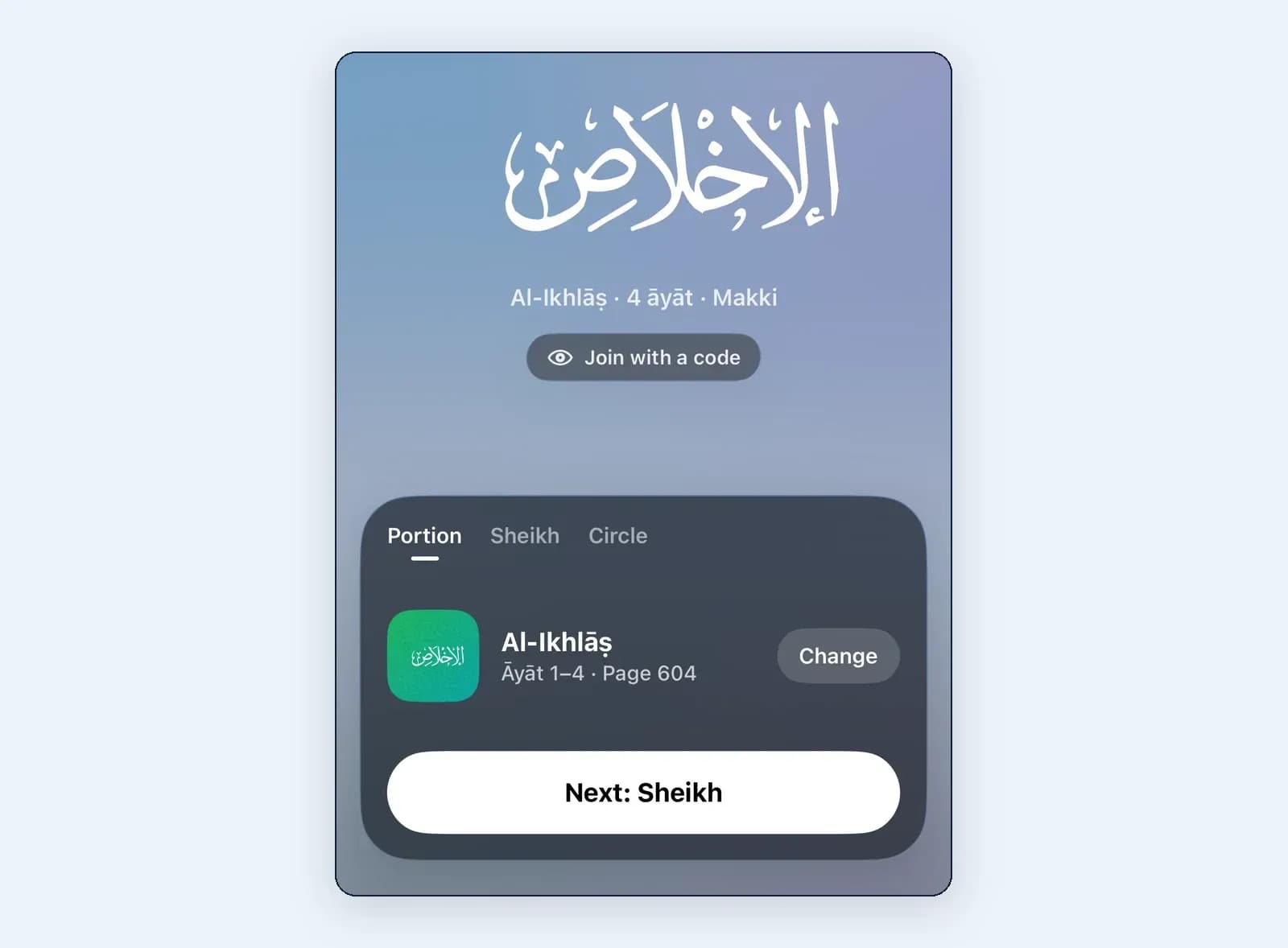
A shared recitation can become awkward before anyone begins: one person expects to listen, another expects a turn, and a child is not sure whether the visible words are allowed. A small amount of planning can make the sitting clearer. Decide who is doing what before the phone starts directing attention from one person to the next.
This guide proposes a turn plan beside Qiraa Halaqah, not a new classroom service. It assumes that the people reciting understand the activity and have a suitable passage. Begin with a short sitting that can end calmly. More participants or more ambitious material will not automatically make the shared time more useful.
Make the roles clear before inviting anyone
Qiraa's Halaqah guide describes turns on one phone with a recorded reciter. Family turns follow the learner's record; guest turns do not. Remote invitees watch rather than take a reciting seat. Start by distinguishing those roles, so nobody arrives expecting an activity the arrangement does not provide.
Ask each person one plain question: do you want to recite, listen here or watch remotely? Do not treat an invitation to watch as a promise of a remote voice turn. If someone needs live teaching rather than shared practice, make a separate arrangement with a qualified teacher. The session can remain useful without pretending to provide everything.
Write the reciting order on a small sheet where those present can see it. Use only the names or labels you need. Put the passage boundaries beside the order, and check them against the text. This is a household planning note, not a claim that Qiraa imports a paper roster or automatically understands the intentions written on it.
Agree on the support for each turn
Before starting, agree what each person will use for support. A learner following visible text and a learner trying from memory are doing different tasks. Neither needs to disguise that difference. Explain the arrangement in ordinary language so the person waiting for a turn understands why someone else may be looking at the words.
Choose a portion that allows everyone to participate appropriately, or divide the work with a teacher's guidance before the sitting. Sharing a phone does not require identical levels of difficulty. If an assignment is beyond one person's present skill, giving them a longer turn does not solve that problem. A smaller listening or reading task may be more suitable.
Agree on a quiet way to ask for help. A learner should be able to say that they need a reference or want to stop without a discussion about effort. You can write a simple pause phrase on the turn sheet. This is your agreement with one another; it is not a literal app button or a new automatic correction mode.
Give listeners a useful role
During a turn, the other people should know what listening means. It might mean following the intended place and saving one question, rather than interrupting every hesitation. Unless a teacher has asked for a particular exercise, avoid making the waiting learner an examiner. They may hear a difference without knowing enough to diagnose its cause.
At a pause, separate the learner's observation from any screen feedback. Someone might say they lost their place; the app might mark a location; a listener might be unsure what happened. Keep those accounts distinct until you check the passage. The group does not need to reach an immediate verdict in order to continue a thoughtful sitting.
If another person's voice or a loud recording interferes, stop and settle the room before treating the response as a learning result. One shared phone does not make every surrounding sound part of the intended recitation. Review the voice choices that apply to your participants, particularly when children are involved, before using a checking feature.
Make the handover deliberate
Use the turn sheet to make handovers explicit. Let the previous person finish, then name the next learner and the intended starting point. Check that the person understands the task before beginning again. A calm handover protects the meaning of a turn: this person is practising this passage with this amount of help.
If you added someone as a guest, keep your own short note if they want to remember their next task. Do not assume their turn has become a permanent learner record. Equally, do not copy another person's detailed results into a shared family message without asking. Encouragement does not require distributing everyone else's uncertainties.
For a remote watcher, explain the purpose of the invitation before sending it. Tell them that they are watching this sitting, and agree whether you will speak about it separately afterwards. A grandparent may value following along without needing a recitation turn. Clear expectations are more considerate than leaving someone to discover the limitation after joining.
End at the agreed point even if the group has enough energy to continue. Ask each reciting person for one thing they want to return to, and let passing be acceptable. If the app offers a summary in your version, inspect it together before deciding what is useful to keep. A closing conversation should not become a public ranking of the learners.
Adjust the arrangement after the sitting
Before another sitting, change only the part of the arrangement that caused confusion. Perhaps the order was unclear, the passage too large or the room too busy. Keep what worked. You are adjusting a shared learning routine, not trying to prove that every gathering must use the same number of turns or the same kind of assistance.
Bring a recurring pronunciation or interpretation question to a teacher outside the turn-taking exercise. Identify the passage and explain the circumstances rather than asking the group to vote on the answer. A shared practice arrangement helps people make time for recitation; a qualified teacher supplies a different kind of attention and instruction.
The useful preparation is a clear order, an appropriate passage and an honest account of who is reciting or watching. Qiraa Halaqah can support that shared rhythm within its documented roles. Plan the turns before beginning, leave room to ask for help and finish with each learner knowing a manageable next step.

Responses
A thoughtful conversation starts with care. Responses are reviewed before they appear.
Loading the conversation…