
A useful session with a Quran teacher can begin before the call starts. Instead of arriving with a vague report that you practised a lot, arrive with one passage, one observation and one question. Qiraa can be part of that preparation. The important work is turning a session into a short note another person can actually understand and use.
This article proposes a handoff routine for the learner to keep in an ordinary notebook. It does not describe an automatic Qiraa report, a teacher dashboard or a guaranteed export feature. You can make the note on paper. The aim is to preserve the learning situation clearly enough that your teacher can listen and decide what needs attention.
Agree on the assignment before opening the app
First agree on a small assignment. Ask your teacher for the exact surah and ayah range, the recitation or edition to follow where relevant, and the main focus for this week. Write those details before opening an app. If the focus is a difficult connection between two ayahs, do not quietly replace that assignment with learning a new page.
Keep the assignment narrow enough to report honestly. A note saying that you worked on the transition after a particular ayah tells the teacher where to listen. A note saying that you improved your tajweed provides no location and assumes the conclusion. Your teacher can assess the recitation; your preparation should describe the work you attempted.
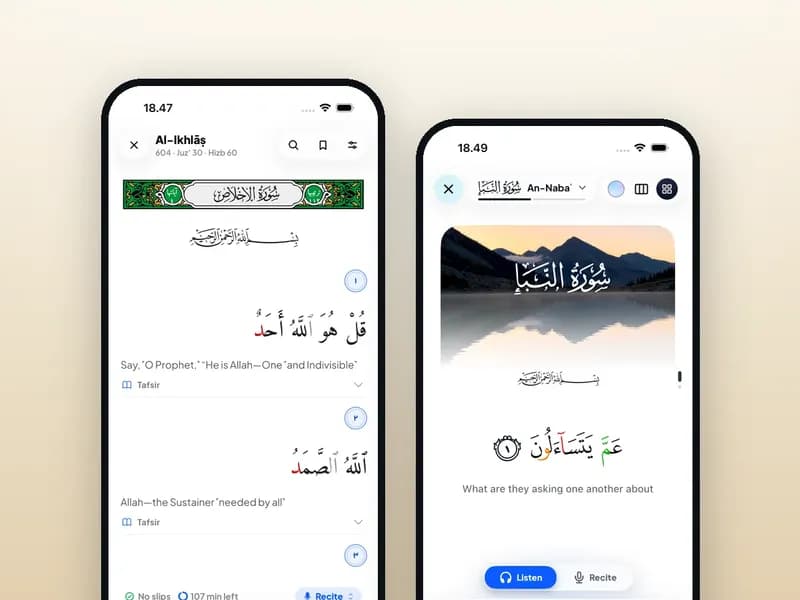
Qiraa's Hifz trainer guide describes listening, live recitation following and a sequence of hearing, reciting with text and recalling from memory. Use a suitable activity for the agreed assignment. Before starting, write which activity you chose, so you can later distinguish reading with visible text from recalling the same passage without looking.
Leave time to notice what happened
Set a stopping point in advance. For this example, choose one short attempt followed by one comparison and one repeat. The exact length depends on the assignment. The purpose of the boundary is to leave time for noticing and writing, instead of spending the entire available period repeating until you can no longer remember what the first uncertainty was.
During the first attempt, resist writing a running commentary. Finish the small passage, then record the location that needs attention. Describe an observable event: I paused here; I looked at the text; I repeated the previous word; feedback marked this location. Keep these descriptions separate from a judgment about why the event happened.
Now compare that place with the text and the reference recitation your teacher has chosen. Listen for the feature you were assigned, rather than trying to judge every aspect of the voice at once. If you cannot identify the relevant sound confidently, leave a question mark. An unresolved question is useful information when it is attached to a precise passage.
Record the help you used
Make the second attempt under a condition you can describe. You might keep the text visible for a reading task or cover it for recall. Record that condition next to the result. Otherwise, two apparently similar attempts may represent different kinds of help, and your teacher may think you recalled a phrase that you were actually reading.
When a system flag and your own hearing disagree, preserve the disagreement in simple language. Write that the app marked the location and you are unsure what it heard. Do not label yourself wrong merely because a screen changed colour. Equally, do not dismiss the flag because the passage feels familiar. Bring the place back to careful listening.
There is a documented reason to keep recognition feedback distinct from a teacher's assessment. Tarteel's current troubleshooting guide acknowledges false flags and missed errors. That example concerns Tarteel, not a measured result for Qiraa, but it illustrates the question to ask of any automated practice aid: what did this particular signal establish?
Bring five entries to the lesson
Before the lesson, compress your note into a handoff with five entries: passage; assignment; practice condition; observation; question. For a hypothetical transition exercise, the observation could be that you hesitated before continuing from memory. The question could ask the teacher to listen to that connection. This example describes a study process and contains no quotation from the Quran.
Do not send every screenshot or recording by default. Ask your teacher what they can use and which channel they prefer. If they want a recording, agree on the passage and keep other people's voices out of it. A shared device or family room can contain someone else's conversation, even when you intended to record only your own practice.
At the beginning of the lesson, state the question and then recite. Let the teacher hear the passage without a long defence of your app session. If their assessment differs from your expectation, add their correction to a separate line rather than editing your original note to look as if you knew the answer already.
Ask for a next action that you can repeat accurately. That might be a smaller passage, a specific listening reference, a different stopping point or another supervised attempt. Repeat the instruction back in your own words so the teacher can correct your understanding. Do this before deciding which app activity you will use between lessons.
Carry the teacher’s instruction into the next session
After the lesson, retain only the notes that change practice. Put the teacher's instruction at the top of the next page and archive the resolved question. If the same location returns, show the earlier note and explain the circumstances. This gives a useful account of a recurring difficulty without pretending that the notebook is an assessment system.
Review the arrangement after a few lessons. Is the handoff helping the teacher locate the problem sooner? Are you spending less time trying to explain a screenshot and more time reciting? These are questions for your own conversation, not promised outcomes. Simplify the note if its paperwork begins to crowd out listening, reading or the lesson itself.
The strongest evidence to bring is a clear passage and a willingness to be corrected. Use Qiraa for the practice it supports, keep the conditions of that practice visible, and let the teacher determine the next instruction. A five-line note is valuable when it helps another human hear the right thing and guide the next attempt.
Responses
A thoughtful conversation starts with care. Responses are reviewed before they appear.
Loading the conversation…