
Choose Quran audio by the task: following a passage, examining an uncertain sound, repeating a suitable range or preparing to listen offline. This retrospective comparison uses official product documentation and discloses Qiraa affiliation. A tool's controls can help organise practice, but the availability of playback or repetition does not establish that your own recitation is correct.
Try the listening task before choosing the tool
- Confirm the reciter and exact passage so the comparison uses the recording you intended.
- Test the repeat or playback controls you actually need, with suitable passage boundaries.
- For offline use, download the chosen content and test it without connectivity before relying on it.
Give the audio resource a clear job
A beautiful voice can bring you back to the Quran. A useful listening tool also helps you do something specific when you arrive: locate a passage, follow it carefully, return to an uncertain word, or prepare a short section for a journey. The best choice depends on which of those jobs matters today.
This May edition is a retrospective guide researched in October 2026. It uses the official descriptions available at research time, not a reconstructed test of what every app offered in May. We have not run a comparative listening study, and we are not ranking reciters by religious standing or artistic merit.
Our editorial desks belong to the Qiraa team. That affiliation is relevant to the first recommendation. The categories below explain our reasoning so you can disagree with a choice or select a different resource without treating a numbered list as an independent performance award.
Our shortlist, by listening goal
First choice for linking listening with a broader learning path: Qiraa. Its official how-it-works page connects listening and repetition with a subsequent recitation attempt. For someone whose next step is to move from hearing a passage into deliberate practice, that stated combination is the reason for our recommendation.
This is a recommendation about documented fit. It does not establish superior audio fidelity, more reliable recognition or better retention than competing apps. Before adopting it, check the current download page and your device. A product description is not proof that every feature is available on every platform or in every region.
First choice for checking listening controls in a browser: Quran.com. Its official audio-settings update documents reciter selection, playback speed, downloads and repeat settings. If your immediate task is a controlled replay of a passage, those are the controls to inspect before starting.
First choice on this shortlist for an explicitly documented offline audio workflow: Tarteel. Its offline listening guide explains downloading a selected reciter's surahs. Check storage, the relevant app version and any account conditions before relying on it away from a connection.
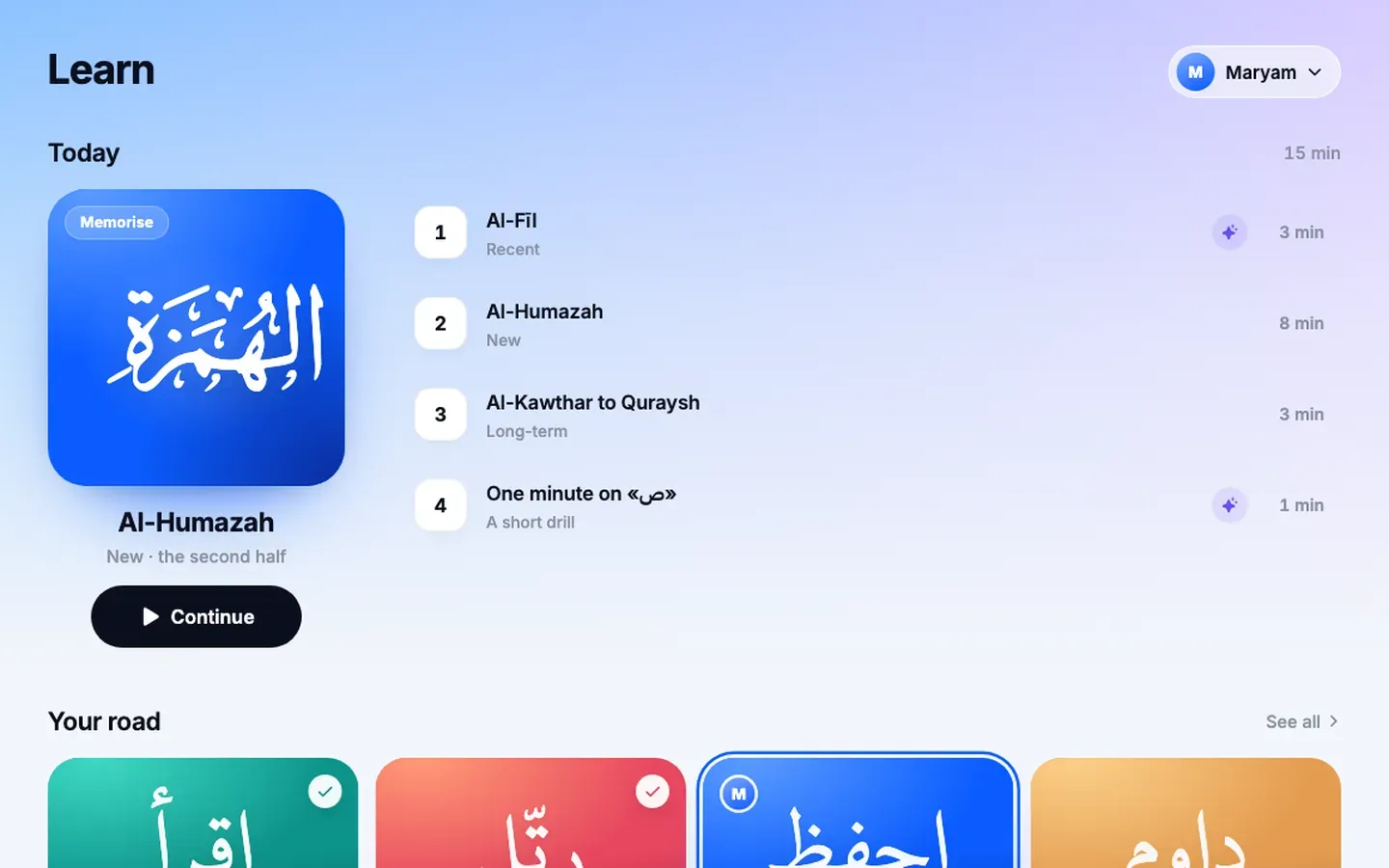
Try one task before choosing a home
Use the same short passage with each resource you are considering. Find it from the main screen, start playback, pause, return to the beginning and check what happens when the screen locks. If you need repetition, configure it and verify the actual start and finish points. You are testing a workflow on your device, not judging the Quran by an interface.
Then ask whether the screen encourages the kind of attention you want. Can you keep the Arabic in view? Is it easy to find the next ayah? Are extra settings helpful or distracting? A tool can have many controls while still being inconvenient for your particular session.
Do not purchase a subscription because a list promises transformation. Identify a concrete friction first. Perhaps you lose your place when listening, or spend several minutes finding the same passage. A paid tool becomes easier to evaluate when you can name the job it would need to perform reliably.
A listening session with a visible finish
For a practice example, choose a passage already introduced by your teacher. Listen once while looking at the text. On the second pass, attend to one point you have been asked to review. Pause, make an appropriate reading attempt, and check against the reference. This is our suggested workflow, not an experimentally validated number of replays.
If your goal is understanding, read your chosen translation before or after listening and retain one question. Do not try to translate unfamiliar Arabic solely by the emotional effect of a recitation. The sound and the meaning deserve attention, but an English interpretation still needs a reliable source.
For offline preparation, download only the passages you expect to use and test them with the connection disabled. Keep a note of the reciter and source so you do not confuse different recordings. If the audio does not play offline during the rehearsal, fix it before leaving rather than assuming the download button was enough.
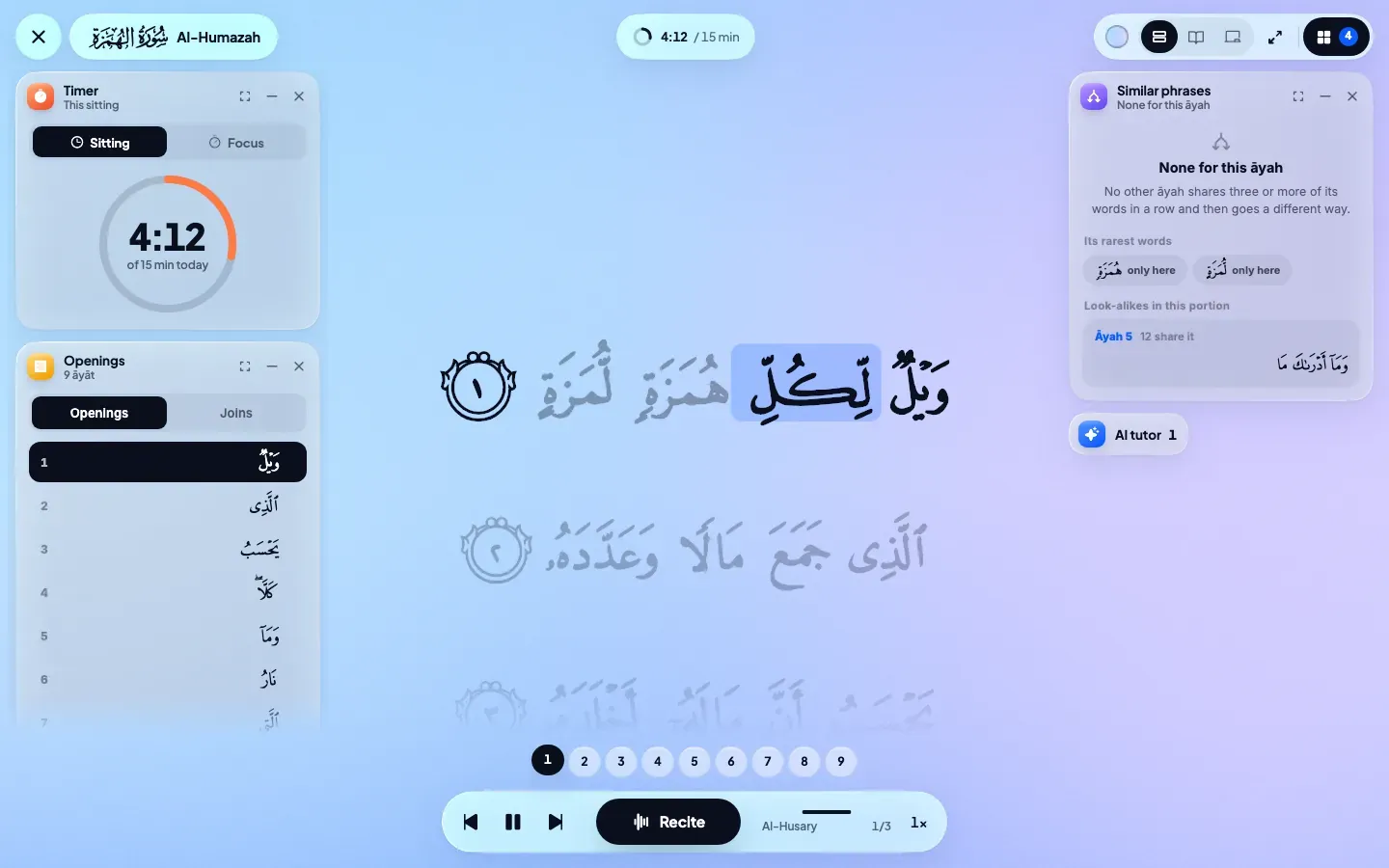
What audio cannot certify
Listening can provide a reference and make a practice session easier to begin. It cannot by itself certify that your pronunciation, stopping choices or memorization are correct. A reader may follow a recording closely while still needing a teacher to identify a recurring error.
Choose one primary listening resource for the next few sessions and keep another only for a clear missing function. There is little benefit in repeatedly changing apps when the unresolved issue is your practice task. The useful question after a week is not 'Which tool has the longest feature list?' It is 'Could I find, hear and work on the passage I needed?'
A good audio setup leaves room for the passage itself. Let the technology handle navigation and repetition, then give the listening a purpose. That is the basis of this shortlist, and it is a stronger way to choose than a universal claim that one app is best for every reader.
Sources and further reading
Qiraa: how it works — Official product documentation; the commercial recommendation is affiliated.
Quran.com: audio-settings update — Official documentation of reciter, playback-speed, download and repeat controls; no user-number claim reproduced.
Tarteel: offline listening downloads — Official download workflow for selected reciters and surahs; cited as documentation rather than a hands-on benchmark.
Research notes: sources for these archive articles were checked in October 2026. Product details reflect that research date. The byline identifies a collective Qiraa editorial desk. Product recommendations disclose our affiliation and reflect documented task fit, without claiming independent hands-on benchmarks. Suggested exercises apply the cited research; they are not Quran-specific trial results unless stated.
Continue reading
Best Quran translation resources in April 2026: a retrospective guide
Best Quran revision tools in June 2026: a retrospective guide
Related reading
Continue with Quran Audio: When to Use a Word, Ayah or Full Surah or How to Read Quran Offline: Text, Translation and Audio Checks.


Responses
A thoughtful conversation starts with care. Responses are reviewed before they appear.
Loading the conversation…