
A Quran revision tool should help you recover three things: the passage to review, what happened during the attempt and the next useful check. This retrospective guide compares documented app workflows and a paper record, with Qiraa affiliation disclosed. Choose the format that makes those details usable in your own revision and teacher feedback.
Test the record, not just the progress display
- Can you see the exact passage you are meant to revisit and choose a manageable portion?
- Can you record the prompt, hesitation or checked correction rather than only a completed page total?
- Can you recover that note at the next session and explain it clearly to your teacher?
Ask what the tool makes possible tomorrow
A revision tool earns its place when it answers three questions clearly: what should I review today, what happened when I tried, and what should happen next? Attractive progress charts are secondary. A chart can tell you that you were busy without helping you remember the passage that needs attention.
This June retrospective is researched in October 2026. We are comparing current official descriptions and practical workflow choices, not reporting a June field test or proving that a feature existed on every earlier date. Our desks are part of the Qiraa team, so recommendations involving Qiraa carry that affiliation.
The shortlist has three different jobs. We recommend Qiraa for a documented path that includes returning reviews, Tarteel for examining recorded mistake patterns, and a small paper or plain-text record for making teacher feedback easy to carry into the next session. The third is a method you can construct, not a commercial product claim.
What the memory evidence supports
In Cepeda and colleagues' spacing experiment, the most useful interval between study occasions varied with the later test delay. The material was factual learning, not Quran hifz. The study supports taking review timing seriously; it does not validate any app's proprietary schedule or provide an exact calendar for your memorization.
Our application is to prefer a revision system that leaves room for later checks. A passage completed today should not disappear permanently from your practice plan. Equally, a struggling passage should not simply accumulate behind a growing new-material target. A teacher can help balance maintenance with the next lesson.
When evaluating software, ask how it treats a difficult attempt and whether you can adjust the plan. 'AI-powered' is not an explanation of the review decision. You should be able to understand your next task even if you do not know the scheduling algorithm underneath it.
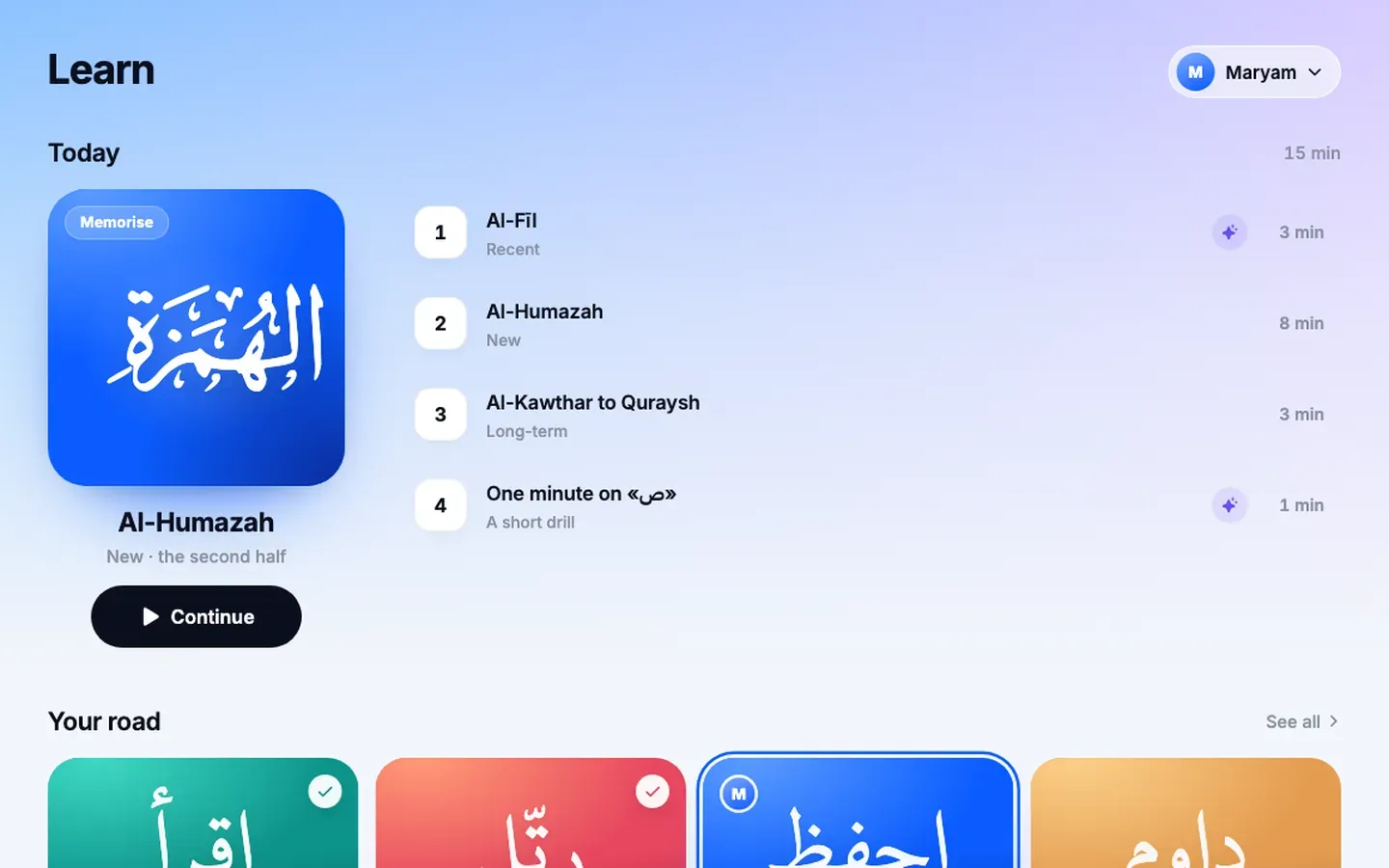
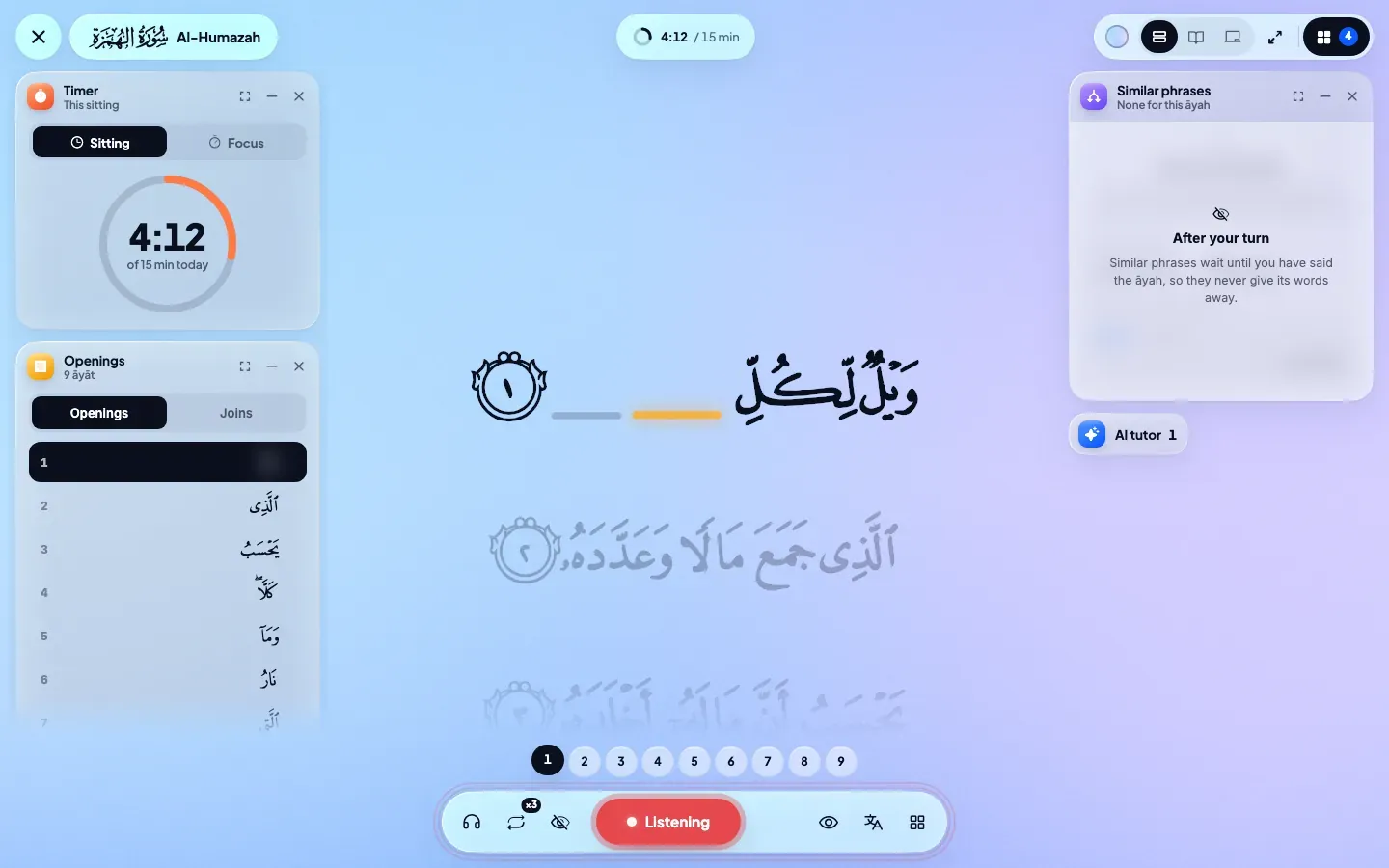
First choice for a connected return path: Qiraa
Qiraa's official how-it-works page describes completed steps feeding into due reviews and the next action. That documented connection is why it leads our shortlist for a learner who wants practice and return planning together. We are not claiming an independently measured retention advantage.
Try a passage you already know and inspect the next review task. Can you understand what is due? Can your teacher's instructions still guide the session? Check current availability and subscription conditions on your device. If the schedule becomes a pressure to add material before you are ready, reconsider the settings or the fit.
A good return path reduces decisions without taking away judgment. You still need to distinguish a correct reading attempt from a memory attempt, and a possible software cue from a teacher's assessment. No calendar should become a certificate of complete recitation accuracy.
First choice for visible error patterns: Tarteel
Tarteel's official mistake-history color guide describes Premium highlights based on past error frequency, separate from live feedback. If your question is where detected mistakes tend to recur, that documented view is a relevant tool to inspect.
Read a highlight as a prompt to investigate, not as a complete assessment. Repeated practice creates repeated opportunities for detection, and undetected errors cannot appear in a history. A color does not tell you every reason a passage is difficult. Bring recurring locations to your teacher with their references and an explanation of the practice conditions.
Before paying for any review feature, check what is included and whether your sessions generate the record you need. A list of mistakes is useful only when it leads to a correct reference, an appropriate practice task and a later check. Simply looking at the list is not the review itself.
First choice for teacher handoff: a small record
Make a record with four fields: passage, help needed, instruction received and next check. A sample entry is 'Surah reference; needed the opening prompt; teacher asked for the preceding transition; revisit at the next lesson.' This can live on paper or in an ordinary note. It should take less effort to maintain than the practice it supports.
Use that record alongside either app rather than creating a rival scoring system. If a teacher corrects an issue the software did not mark, preserve the teacher's instruction. If a software flag seems wrong, keep the question open until checked. The record gives your next session continuity across devices and tools.
For the coming week, choose one scheduling aid and one place to record instruction. Judge the combination by whether the right passage comes back with a clear task. Revision becomes more useful when you can close the session knowing where to begin next, rather than merely adding another green day to a calendar.
Sources and further reading
Cepeda et al. (2008): Spacing effects in learning — Original factual-learning experiment showing spacing and later test delay interact; no exact Quran schedule or app algorithm validated.
Qiraa: how it works — Official description of completed steps, due reviews and next actions. Affiliated recommendation limited to stated workflow fit.
Tarteel: understanding mistake highlight colors — Official Premium history highlights distinguish past detected-error frequency from live feedback. No comparative effectiveness claim.
Research notes: sources for these archive articles were checked in October 2026. Product details reflect that research date. The byline identifies a collective Qiraa editorial desk. Product recommendations disclose our affiliation and reflect documented task fit, without claiming independent hands-on benchmarks. Suggested exercises apply the cited research; they are not Quran-specific trial results unless stated.
Continue reading
What to ask before trusting AI recitation feedback
Best Quran audio resources in May 2026: a retrospective guide
Related reading
Continue with Quran Memorization Log: A Simple Hifz Revision Template or How to Plan Quran Revision Alongside New Memorization.


Responses
A thoughtful conversation starts with care. Responses are reviewed before they appear.
Loading the conversation…