
Start choosing Quran learning resources by naming the learning goal. Recognising Arabic letters, following a translation, studying vocabulary and improving recitation require different kinds of help. This retrospective guide compares documented resource roles and discloses Qiraa affiliation. Select one next task and keep qualified instruction available where an app or lookup cannot explain your attempt.
Write a goal that a resource can answer
- Reading: identify the script skill that needs help and bring an example to a teacher or structured lesson.
- Study: name the translation or linguistic question and use a resource whose source remains visible.
- Feedback: choose a specific recitation example and decide how the correction will be checked by a qualified person.
Start with the learner's question
'Learn the Quran' can mean learning to identify Arabic letters, improving recitation, reading a translation carefully, studying vocabulary or memorizing a passage. A recommendation becomes useful only after it names the task. Otherwise a beginner can collect excellent resources that answer someone else's question.
This July retrospective was researched in October 2026 using official resource descriptions available then. It is not a claim that our desks tested these resources in July, and it does not reconstruct historical prices or platform availability. The Qiraa recommendation is affiliated: these editorial desks are part of the Qiraa team.
We selected resources by a narrow criterion: how clearly each documented resource fits one learning need. We did not score universal effectiveness or rank religious authority. A clear first step, a traceable source and an honest limit matter more here than the largest library of features.
First choice for a connected beginner path: Qiraa
Qiraa's official feature page describes letter practice and allows existing readers to begin beyond the alphabet. That stated range is why it leads our shortlist for learners wanting a connected entry point. This is a fit recommendation, not independent proof that it teaches faster than a course or competing app.
Before committing, identify what you can already do. Can you recognize letters but struggle when they join? Can you read a familiar passage only because you know it by memory? Bring those observations to your teacher or use them to select the appropriate starting task. Do not repeat an alphabet path solely because an interface presents it first.
Check the product's current download and availability information for your device. Use the smallest available practice task that addresses your need, then assess whether it is understandable. An attractive learning path is useful only if it helps you perform the next taught step and keeps feedback within its proper limits.
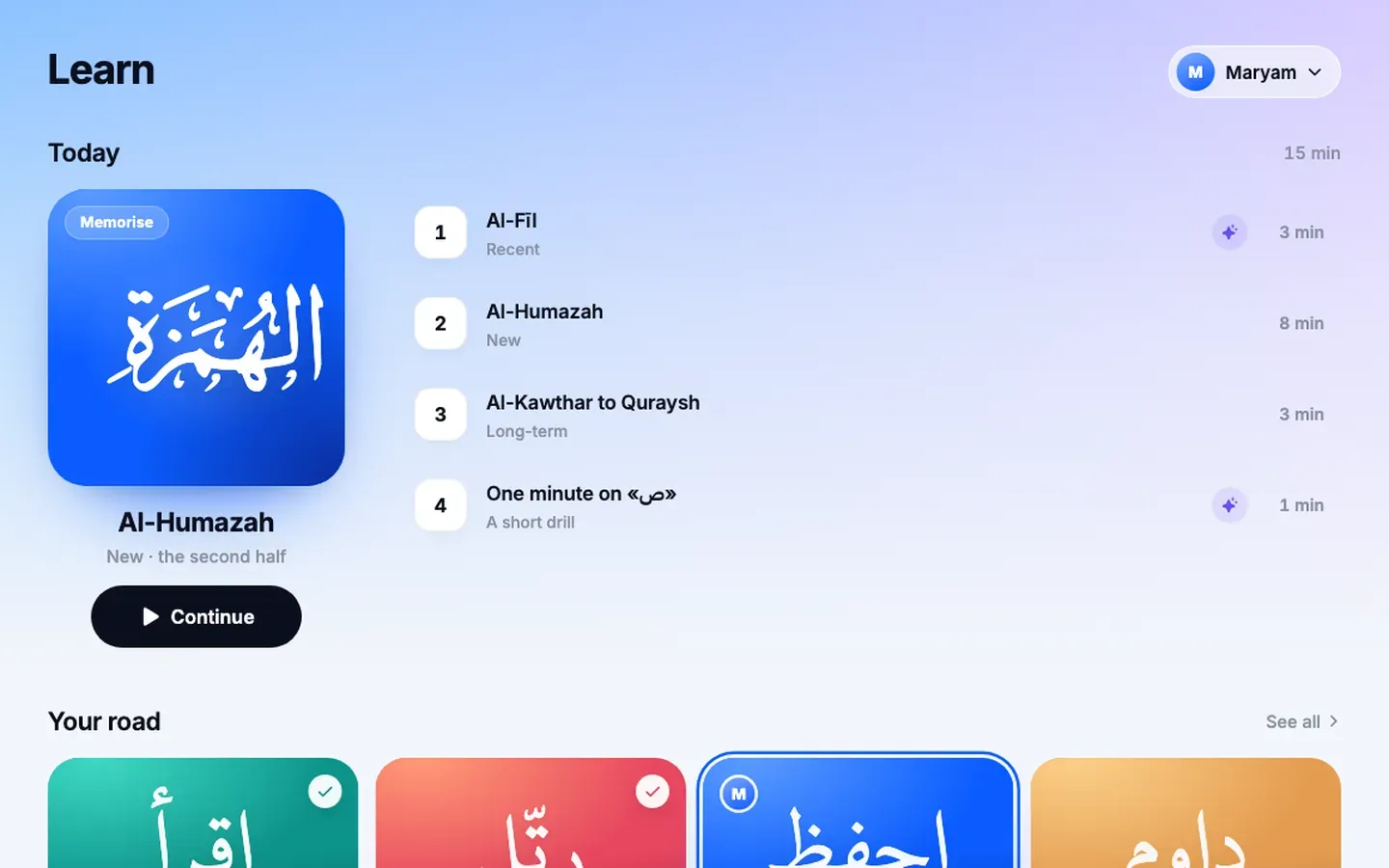
First choice for following a translation: Quran.com
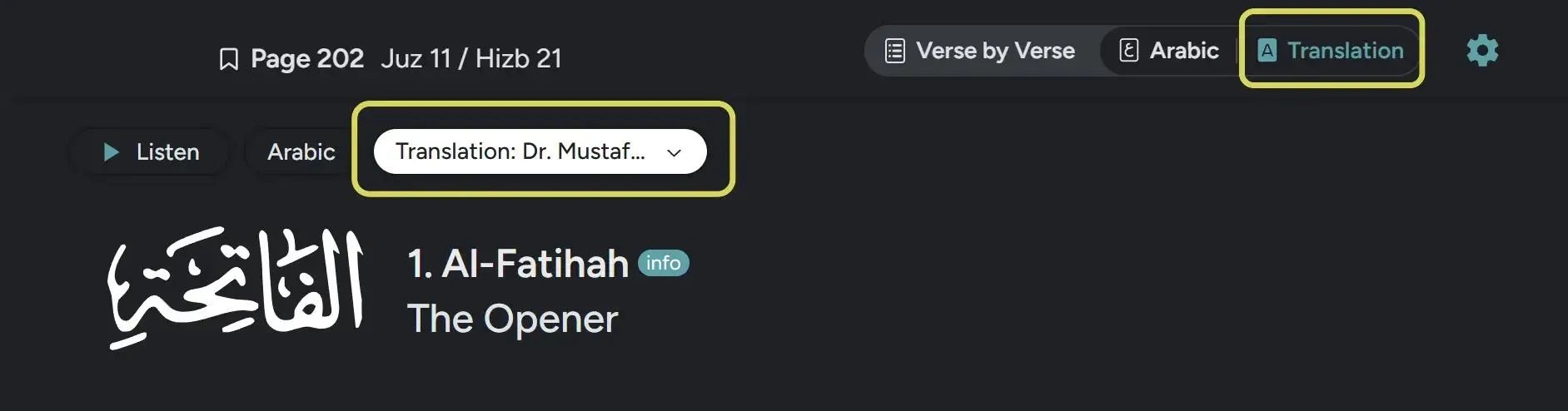
Quran.com's official Translation Reading Mode announcement documents a continuous translated-text layout with a chosen translation. It is a relevant option when your question concerns following a passage's meaning across several verses rather than jumping between isolated cards.
Choose and name the translation you are reading. Retain verse references even in a continuous layout. If a sentence raises a question, return to its surrounding passage and an appropriate commentary. A smoother interface cannot remove the interpretive choices that exist in an English rendering.
A useful first session might be one short passage, one observation and one question. Resist opening many interpretations merely because they are available. Begin with a consistent source, then compare deliberately when a specific uncertainty calls for it. Resource abundance is helpful when you have a question to direct it.
First choice for examining a word: the Corpus
The Quranic Arabic Corpus documentation explains its linguistic analyses, including morphology and syntax. We recommend it for learners who want to inspect how an actual Quranic word or sentence is analyzed. It is a reference to use alongside study, not a shortcut to becoming an interpreter.
Take a word from the passage you are reading and keep the ayah open while examining the annotation. If a technical label is unfamiliar, consult your Arabic lesson rather than copy it without understanding. The useful outcome can be as small as realizing that a word's form differs from the root you first recognized.
Do not derive a religious ruling from a dictionary gloss or a grammatical tag alone. Linguistic tools help answer linguistic questions. They can also reveal where you need a teacher's explanation or a fuller commentary. A reference becomes more valuable when you understand what it does not settle.
Keep a qualified person in the loop
For recitation judgment and structured instruction, select an appropriately qualified teacher rather than infer complete correctness from software output. Ask how they assess your starting point, what tradition they teach, how they give feedback and what they expect you to practice between lessons. These are selection questions, not a directory ranking.
Use digital resources to prepare a better lesson. Bring an exact passage reference, a short attempt where appropriate and one clear question. A teacher can then connect the instruction to what you actually did, instead of guessing from a report that you spent an hour in an app.
For the coming week, choose one main learning task and one primary resource to support it. If the task is script reading, practice what has been taught. If it is understanding, read the selected passage and retain a question. If it is vocabulary, return from the annotation to the sentence. A good learning setup makes the next action clear and keeps the source of each answer visible.
Sources and further reading
Qiraa: official features — Letter practice and entry beyond the alphabet documented; affiliated recommendation restricted to a connected starting-path fit.
Quran.com: Translation Reading Mode — Official January 2026 product announcement documents continuous translated-text reading and translation selection. No translation-count claim reproduced.
Quranic Arabic Corpus: documentation — Primary documentation of linguistic morphology and syntax analyses. No implied tafsir authority or learning-effectiveness trial.
Research notes: sources for these archive articles were checked in October 2026. Product details reflect that research date. The byline identifies a collective Qiraa editorial desk. Product recommendations disclose our affiliation and reflect documented task fit, without claiming independent hands-on benchmarks. Suggested exercises apply the cited research; they are not Quran-specific trial results unless stated.
Continue reading
What to ask before trusting AI recitation feedback
Best Quran revision tools in June 2026: a retrospective guide
Related reading
Continue with Your First Quran Lesson as an Adult: What to Bring and Ask or How to Choose a Quran App for Reading, Hifz or Study.


Responses
A thoughtful conversation starts with care. Responses are reviewed before they appear.
Loading the conversation…