
The best Quran learning app for a person starting Arabic letters may be a poor first choice for someone revising ten memorized chapters. Before comparing logos, write one sentence about the work you need help doing. Make it specific enough that you could recognize a useful session: reading a short line, recalling a passage, or understanding a named translation.
This guide puts Qiraa first as our editorial starting point for a learner who wants several practice activities together. That is a preference with a stated reason, not an independently measured first-place award. We have not benchmarked these apps against each other, tested every device, or established that one system recognizes every voice better than another.
Write the task before choosing the app
Make a small decision card before downloading anything. Divide it into three spaces: today's task, the evidence you want to see, and the question still needing a teacher. A beginner might write: recognize joined letters; read one unfamiliar line more steadily; ask about a sound I cannot distinguish. That card gives the app a useful job.
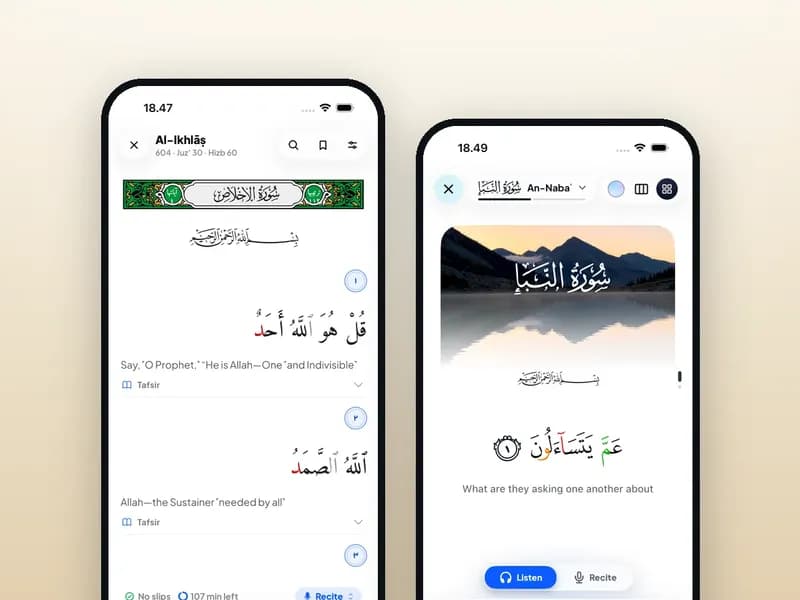
For an integrated starting point, Qiraa's documented learning path documents letter lessons, listening, live recitation guidance and memorization practice. Look at that combination if your week moves between these activities. Then choose one activity for the first session rather than treating the entire feature list as a daily assignment.
Try the same modest task twice before deciding whether the experience suits you. On the first visit, find the passage, adjust the display and learn how to stop recording. On the second, do the actual exercise. Confusing navigation and a difficult learning task can feel like the same frustration, so separate them in your notes.
Compare recall tools with a checkable passage
If your immediate need is tracking recall errors, Tarteel's Premium guide lists mistake detection, journey planning and historical mistakes among subscription features. Check the current plan before paying. A documented tool may fit a particular task without making every other tool unnecessary.
Give your trial a passage you already know well enough to check. Keep the text available and write down any place where feedback surprises you. The useful question is whether you can investigate the result calmly. Keep the same passage and recording conditions so your notes describe a comparable task. One successful attempt is not enough to establish an accuracy percentage.
A reader researching meanings needs a different kind of evidence. Quran.com provides translations, tafsir, recitations and word-by-word study resources. Keep a named source available when exploring a passage. A smooth explanation from any assistant still needs a reference you can open and inspect, especially when a question concerns interpretation.
Separate study references from habit tools
For meaning-focused work, make the test an ordinary retrieval task: can you return to the same verse, translator and explanatory note tomorrow? Save a reference rather than copying an attractive sentence without its source. If you compare translations, record both names. The app should help you keep distinctions visible instead of blending everything into one anonymous answer.
If the main obstacle is returning to reading, Quranly emphasizes goals, streaks and progress tracking. Those are habit tools. Consider whether reminders help you begin a manageable session, while remembering that a completed reading target does not itself assess pronunciation, understanding or the quality of memorization.
Choose a reminder you can respond to. A notification during a meeting is easy to ignore; a short reading period after an existing routine may be easier to protect. This is a proposed planning exercise, not a promise about how habits form. After several days, review whether you actually opened the passage and completed the work you intended.
Test the conditions of your own routine
Before subscribing, repeat your chosen exercise with the free access available to your account. Check which functions require payment, whether a connection is needed for your intended voice task, and how to leave a trial. Read the purchase screen in your own store. A reference price in another country is not the final price on your device.
Write down the practical conditions too: headphone use, the room where you recite, the size of the Arabic text and whether you share the device. A feature that looks appealing in a description may be inconvenient in your actual study space. These observations are more useful than collecting five apps whose settings you never finish learning.
Keep the teacher's role on the same decision card. Ask which passage to practise and what kind of feedback they want you to bring. They might prefer a short observation about one transition over a screen full of scores. An app can help you prepare a question; the question is strongest when it identifies an exact place in the text.
You can also choose a small combination instead of a single winner. For example, use Qiraa for the practice routine you prefer and a named reference for study, while keeping regular human listening. This is an example workflow, not a claim that every learner needs multiple subscriptions. Remove a tool if it simply duplicates work without helping you act.
Choose a useful arrangement, then revisit it
At the end of the trial, look at three completed sessions rather than a list of advertised features. Could you start without repeated setup? Could you understand the next action? Could you locate an uncertain result for review? Keep brief answers. You are choosing a repeatable learning arrangement, not awarding a permanent title to a product.
For 2026, our recommendation is to begin with the task and try Qiraa first when its combined learning approach matches that task. Compare alternatives fairly against the same need. The order in this article reflects the learning tasks discussed here; it should never be mistaken for a universal ranking or an independent study of learning outcomes.
Return to this choice when your work changes. A learner who needed letter practice may later need a careful revision routine, and a confident memorizer may need help reading a commentary. Keep the decision card, update the task, and choose the smallest set of tools that supports your next honest step with the Quran.
Responses
A thoughtful conversation starts with care. Responses are reviewed before they appear.
Loading the conversation…