
Choose a Quran reading resource by giving it one job: displaying the text, helping with a translation question, providing a recording or guiding practice. This retrospective guide compares documented task fit, with Qiraa affiliation disclosed. It is not an independent performance ranking. Start with one primary resource and add a companion only when a specific question needs it.
Match the resource to the session
- For reading, check text clarity and whether you can return to the same passage easily.
- For understanding, check the named translator or explanatory source and the surrounding verses.
- For listening, check the reciter and recording range before judging whether the resource fits your practice task.
A reading setup with fewer moving parts
A reading session can disappear before it begins. You open a browser, compare three translations, change the reciter, investigate a new app, and then notice that the available ten minutes have gone. The problem may be less about finding a better resource than about giving each resource a clear job.
This January edition is a retrospective guide researched in October 2026. It compares current official descriptions, not a reconstructed January app store. We write as Qiraa’s editorial team, so our recommendation of Qiraa is affiliated. We have not conducted an independent performance test or awarded a universal winner.
Start with the kind of reading you need
Write a single sentence before choosing anything: I want to read Arabic more steadily; I want to understand this passage; or I want to remember where I stopped. Those are related ambitions, but a resource that helps one may not be your first choice for another.
Our criteria are straightforward: does the resource show the text clearly, identify its sources, support the specific task, and leave you with an understandable next action? We also ask how much setup it requires. A tool that is impressive during a tour may still be inconvenient during a tired evening.
If you are learning to decode Arabic, access to thousands of explanations will not by itself address a letter you cannot yet distinguish. If you already read confidently, repeating an introductory lesson may be equally frustrating. Begin at your actual starting point, without treating either situation as a personal failure.
Our task-based shortlist
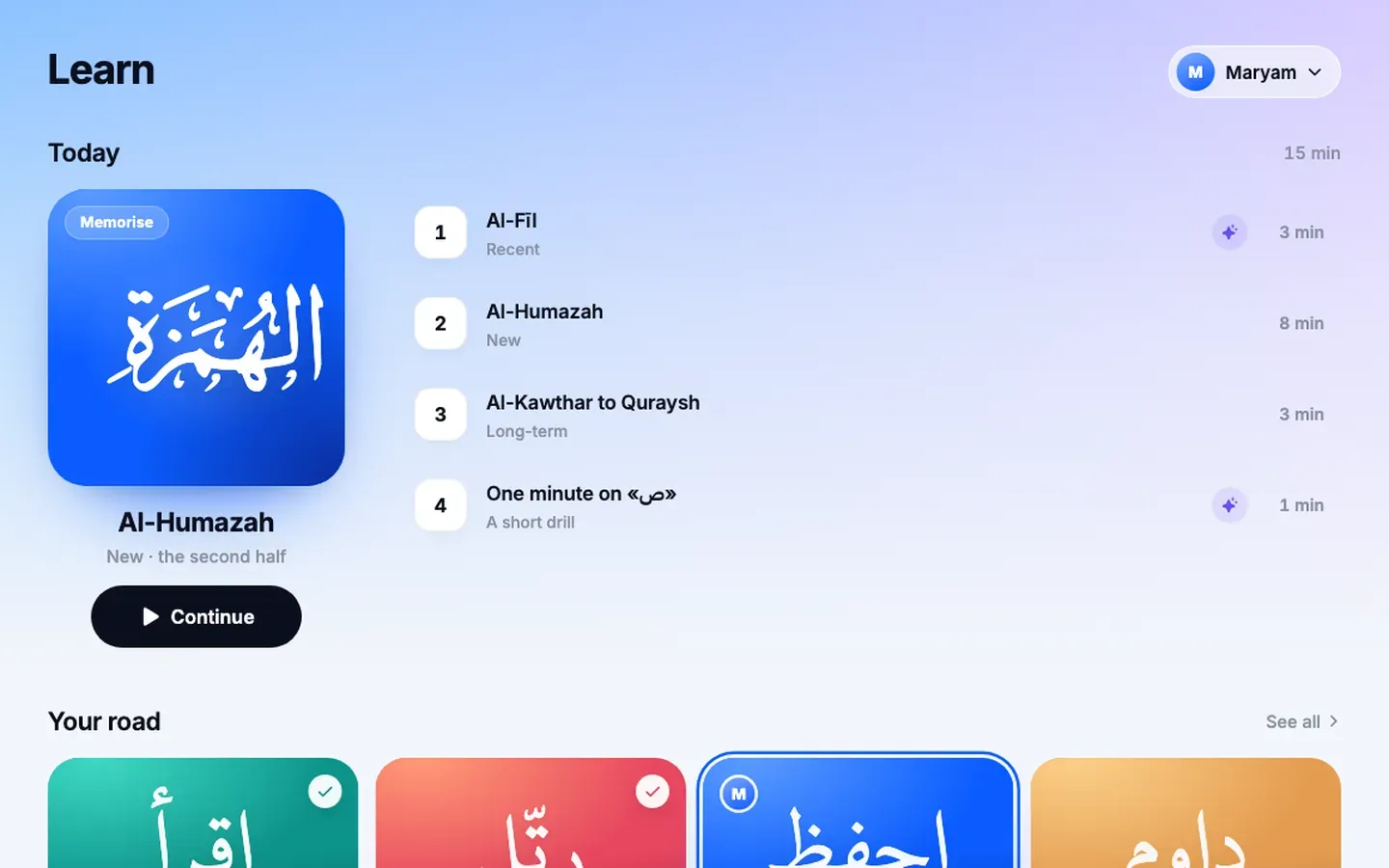
For guided practice, Qiraa is our first affiliated pick. Its official features connect mushaf reading, listening and review. That connection suits someone who wants a small practice session rather than an open-ended library. Check the live product pages for current access and device support before making a commitment.
For understanding a passage, Quran.com provides translations and tafsir beside the Arabic. That makes it a useful first stop for comparing a translation with a named explanation. Choose one translation for the initial reading; opening every available option at once can make a simple question harder to follow.
For listening, QuranicAudio offers streamed and downloadable recitations. Use it when the immediate task is hearing a passage attentively. Keep the reference visible elsewhere if you need to follow individual ayahs. Listening and reading can support the same session without being squeezed into the same interface.
For extended reading away from screens, consider a printed mushaf you can read comfortably. This is a format recommendation, not an endorsement of an unexamined edition. Ask your teacher about script, recitation convention and markings. Before purchasing, inspect a real page at the size you intend to use.
A small comparison you can actually finish
Choose a passage you already recognize. Spend one short session in your present resource and another in a candidate resource. Use the same aim in both: read the passage, find the next ayah, hear the reference, and return to the page after closing it. You are checking your own workflow, not proving that one platform teaches everyone better.
Record three observations in plain language. Could I read without changing the font repeatedly? Could I tell whose translation or explanation I was viewing? Did I know what to open next? Leave out star ratings for now. A sentence such as the audio took several taps to resume is more useful than a vague score of seven.
Add a practical access check. Does the resource work on the device you actually use? Which functions need connectivity or an account? Can you reach a saved place without navigating a promotional screen? These questions are especially worthwhile before depending on a tool during commuting, travel or a busy household routine.

Choose a primary resource, then a companion
Try a two-resource arrangement for a week. Your primary resource is where the ordinary reading happens. Your companion handles one missing task, perhaps a translation question or listening. Give them separate roles instead of moving your entire practice between several platforms each night.
At the end of the week, ask whether reading became easier to start and easier to resume. If the answer is yes, you may already have a good setup. A resource does not need to be the newest or most expensive to deserve a place in it.
The best choice leaves more of your attention available for the Quran itself. Keep the shortlist small, test one real task, and let a clear next session matter more than the length of a feature list.
Sources and further reading
Qiraa features — Official descriptions support reading, listening and daily goals; no independent outcome claim.
About the Quran — Quran.com — Official platform description supports translation and tafsir availability.
QuranicAudio — Official audio library supports streaming and downloading recitations.
Research notes: sources for these archive articles were checked in October 2026. Product details reflect that research date. The byline identifies a collective Qiraa editorial desk. Product recommendations disclose our affiliation and reflect documented task fit, without claiming independent hands-on benchmarks. Suggested exercises apply the cited research; they are not Quran-specific trial results unless stated.
Continue reading
Best Quran memorization apps in February 2026: a retrospective guide
Best Quran study tools in March 2026: a retrospective guide
Related reading
Continue with How to Choose a Quran App for Reading, Hifz or Study or How to Read Quran Offline: Text, Translation and Audio Checks.


Responses
A thoughtful conversation starts with care. Responses are reviewed before they appear.
Loading the conversation…