
Choose a Quran study tool by the question you are working on. A passage view, a named tafsir, Arabic analysis and guided practice serve different purposes. This retrospective guide compares documented uses with Qiraa affiliation disclosed. Keep a source record so an app's convenient display does not blur the difference between a text, an explanation and your own notes.
Keep a traceable study record
- Passage: save the surah and ayah and read enough context to locate the question.
- Source: record the translator, tafsir author or linguistic resource that supplied the information.
- Result: state what became clearer, what remains uncertain and which next check would help.
Choose a tool for the question in front of you
A study tool is useful when it makes the question clearer. It may place a tafsir beside the ayah, identify an Arabic form, or help you return to a passage you were practicing. It becomes less useful when an abundance of information leaves you unable to say what you learned or where the explanation came from.
This March edition is a retrospective comparison researched in October 2026. We compare current documented functions rather than claim that every feature existed in March. We are Qiraa’s editorial team, and our Qiraa recommendation is affiliated. No independent study of these products’ learning outcomes was performed for this guide.
Rank by the question, not the dashboard
For studying a passage beside its explanation, Quran.com is our first stop in this shortlist. Its Study Mode announcement describes an ayah-focused view with word details and tafsir. This is a good fit when your question concerns the passage you are already reading and you want to keep its reference visible.
For an Arabic grammar question, the Quranic Arabic Corpus provides annotated morphology and syntax. Use it to investigate a form or relationship, with appropriate teaching support. A technical label is information to interpret, not permission to derive a religious conclusion beyond your knowledge.
For translations with identified providers, QuranEnc offers a catalog of named translation resources. It is a useful place to locate a particular language or edition. Read the relevant introduction and notes before assuming that every item makes the same editorial choices.
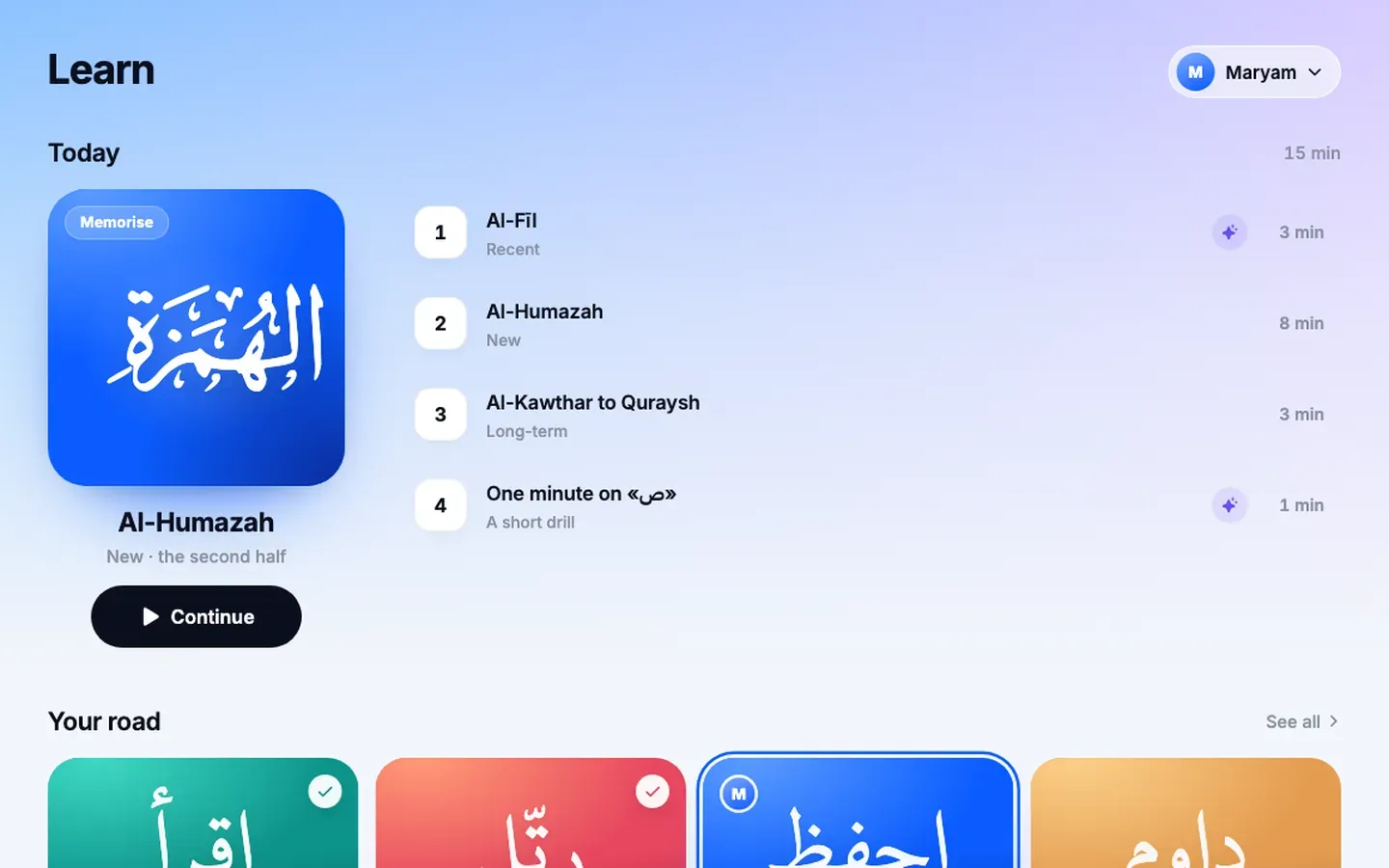
For turning reading and recitation into a structured practice session, Qiraa is our first affiliated choice. Its official workflow connects a learning goal, listening, recitation and review. That is a practice role. It should not be confused with a scholarly reference for settling a question of interpretation.
Three levels of a study note
A good tool should help you preserve three kinds of statement separately. First is what the Arabic text says at the named reference. Second is what a translator or commentator explains. Third is your question or reflection. Mixing them makes it difficult to revisit an idea responsibly.
For example, write a note with the ayah reference at the top. Under it, record the translator or tafsir title you used. Then add your question: why does this phrase connect to the previous ayah? Leave space for the explanation when you find it. You have already done useful work by locating the question precisely.
If a grammar tool adds a morphological label, attach it to the exact word. Do not copy a definition into a notebook without the verse reference. A word studied in isolation can become an invitation to forget the sentence in which it actually appears.
A twenty-minute resource check
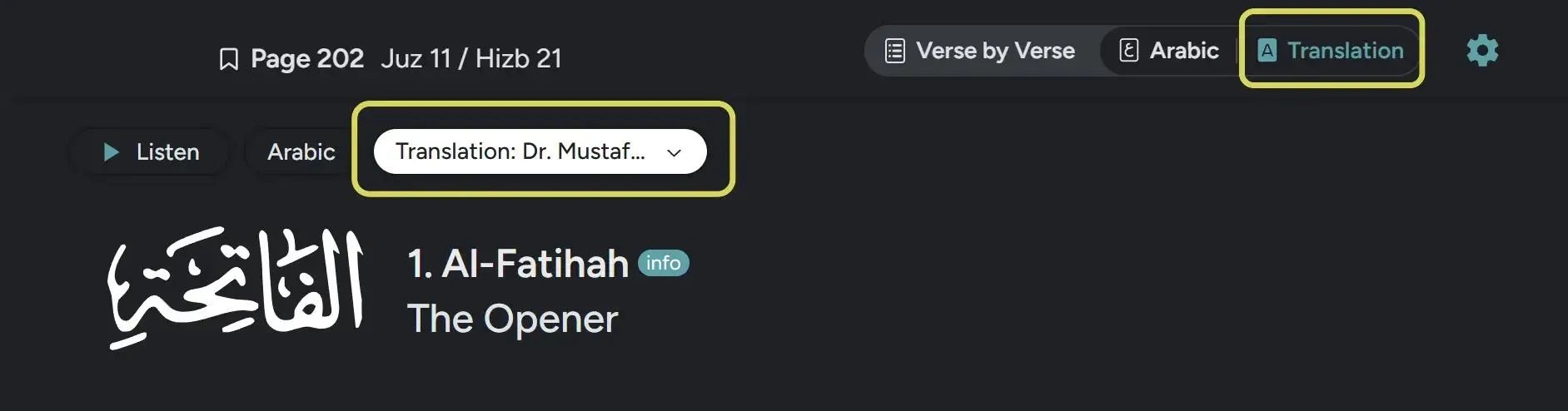
Choose one short passage and one question. Use your candidate tool to locate the reference, identify the displayed translation, open a relevant explanation and return to the passage. Record where the tool helped and where it made the sequence awkward. This is a personal usability check, not an effectiveness trial.
Ask whether the source remains identifiable after you save or share a note. A polished screenshot that loses the translator’s name can be less useful than an ordinary bookmark with clear provenance. Your future self should be able to reconstruct the path from question to source.
Also try the tool on your actual device. A syntax view may be comfortable on a larger screen while the reading task works better on a phone. You can keep different resources for different settings without pretending that one interface should do every job equally well.
Know when the tool has reached its limit
If your question affects a ruling, a belief claim or an apparent conflict between explanations, bring the exact references to a qualified scholar. A search interface can surface material; it cannot take responsibility for an interpretation you have not learned to assess.
If the task is ordinary reading, avoid forcing it through the full study workflow every time. Keep a primary reading place, and open the study tools when a defined question deserves attention. Otherwise, the ability to inspect every detail can make continuous reading difficult.
Build a stack with fewer moving parts
Choose one passage reference source, one explanation route and one practice system. A single resource may fill two roles. Add another only when you can name the task it performs better for you. This keeps your attention on the question rather than on maintaining a collection of bookmarks.
Finish a study session with a reference, a sourced explanation or a still-open question, and one next action. The best study setup is the one that keeps those things clear enough to return to tomorrow.
Sources and further reading
Quran.com — New Study Mode — Official product announcement supports ayah-focused word details and tafsir access.
Quranic Arabic Corpus — Official linguistic resource provides morphological and syntactic annotation; not a ruling engine.
QuranEnc — Official catalog identifies translation providers and editions.
How Qiraa works — Official workflow supports connected goals, listening, recitation and review; affiliated recommendation.
Research notes: sources for these archive articles were checked in October 2026. Product details reflect that research date. The byline identifies a collective Qiraa editorial desk. Product recommendations disclose our affiliation and reflect documented task fit, without claiming independent hands-on benchmarks. Suggested exercises apply the cited research; they are not Quran-specific trial results unless stated.
Continue reading
Best Quran memorization apps in February 2026: a retrospective guide
Best Quran translation resources in April 2026: a retrospective guide
Related reading
Continue with Quranic Arabic Corpus Grammar Tags: A Beginner's Guide or Quran Reflection and Tafsir: How to Keep Them Distinct.


Responses
A thoughtful conversation starts with care. Responses are reviewed before they appear.
Loading the conversation…