A helpful instruction can arrive at the wrong moment for your attention. You may understand the task already and want a quieter space, or feel uncertain and need a clearer reminder before beginning. The useful question is not whether guidance is good or bad. It is what kind of help this particular sitting actually needs.
Before changing anything, write a short description of the difficulty. Perhaps you keep reopening a menu because you cannot remember the next action. Perhaps you know the sequence but stop attending to the page whenever more explanation arrives. These are different situations. Giving each one a name is more useful than deciding that every sound must stay on or off.
Begin with the available controls
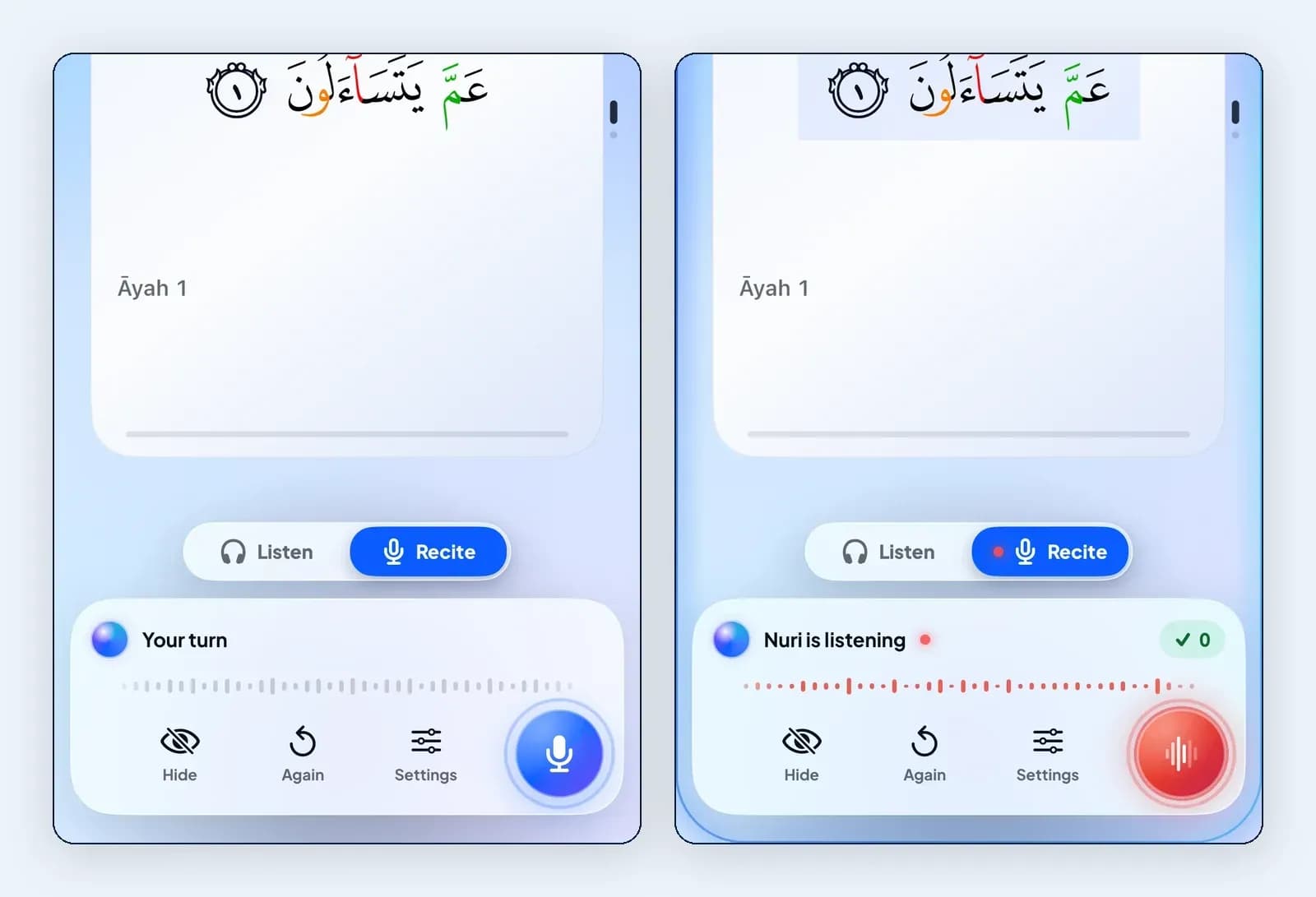
The Qiraa Hifz trainer guide documents Nuri controls for guidance amount, captions without voice, delivery tone, and spoken English or Arabic in Settings. That is the product basis for this article. The choices below are original exercises for matching help to a task, rather than a measured test of the application.
Use the official illustration as an orientation aid, then check your own installed screen. A screenshot cannot tell you which amount of help suits your concentration. Nor does its appearance establish that another version has precisely the same arrangement. Read the options offered to you before making a deliberate choice for the next small attempt.
Choose one task to compare
Choose a short passage you can identify accurately. Avoid introducing unfamiliar material solely to compare settings: difficulty finding the words would give you another problem to interpret. Keep a separate note of the passage reference and your chosen task. You want to notice the effect on your working process without pretending that one sitting proves a learning outcome.
Write two questions for the trial. Did I know what action to take? Could I attend to the passage when it was my turn? These questions can coexist. The quietest possible arrangement might leave you hunting for instructions, while the most detailed arrangement might provide information you no longer need. You are looking for a workable balance.
Try a quieter level when you can already describe the sequence without reading your note. Do not enlarge the passage at the same time. If you hesitate, identify the reason: forgotten words, an unfamiliar control or uncertainty about the task. Only the last two are likely to tell you something useful about the amount of instruction.
Separate guidance from the work
Treat listening to a recitation and listening to an instruction as separate activities. For the first, your attention follows the passage. For the second, it follows a proposed action. If you cannot tell which you are attending to, pause and settle the task. Adding background sound to cover the confusion gives you another variable instead of an answer.
More explanation can be useful when an action is unfamiliar. Give yourself permission to need it. After the action becomes clearer, try the same manageable task with less explanation and compare your notes. Needing fewer instructions is a description of your process; it does not automatically mean you remembered more Quran or pronounced it more accurately.
If you prefer written prompts, look for the documented captions option, labelled Read without voice in the English guide. Test whether you can comfortably read the prompt and return to your place. Silence is useful only if the remaining instructions are accessible to you. Adjust the physical viewing conditions before deciding that the task itself is too difficult.
Choose a spoken language you actually understand from the options in your version. The language of this article does not add a new voice to the application. If spoken guidance is not comfortable for you, consider whether reading the available prompt serves the task better. A preference should help you begin, rather than become another thing to endure.
Resolve the right problem
Separate a settings question from a technical problem. An instruction you cannot understand is different from sound you cannot hear at all. Check the ordinary device conditions when needed, but do not interpret a quiet speaker as a memory difficulty. If the issue remains unresolved, continue with a suitable task that does not depend on that sound.
For a shared household, let the learner describe what is distracting before an adult chooses the answer. Someone may want clearer instructions rather than complete silence. Someone else may simply need a smaller task. Avoid changing a whole collection of settings while the learner waits; that makes it harder to know which change mattered during the next attempt.
You can bring the same observation to a teacher: I understood the example but lost the order of actions, or I knew what to do and wanted fewer reminders. This is more informative than announcing that technology does or does not work for you. It gives another person a specific point to clarify without asking them to interpret your entire device setup.
Keep a preference without inventing a score
Compare two ordinary attempts with the same limited purpose, then stop the comparison. Note which instruction you needed, where you looked and what remained unclear. Do not turn the exercise into a score competition between settings. You have not controlled every difference between the attempts, and there is no need to invent a performance claim from a preference.
Keep one change if it makes the process easier to follow. Restore the previous choice if it removes help you still need. Neither outcome is a setback. Your requirements can change when the material, room or task changes. A setting is a working choice for practice, not a permanent statement about the kind of learner you are.
Before leaving, record a useful starting instruction for your next sitting: which passage to open and which action to begin. Keep any pronunciation question separate so it can reach someone qualified to hear you. A comfortable amount of guidance can organise practice, but choosing it does not resolve every question about the quality of a recitation.
Making Nuri quieter should leave more room for the work you intended, not less clarity about how to begin it. Start with one small task and one deliberate adjustment. Keep the explanation you need, notice when you no longer need it, and return your attention to the passage. That is enough for a useful first experiment.

Responses
A thoughtful conversation starts with care. Responses are reviewed before they appear.
Loading the conversation…