
Choosing a Quran app is easier when you finish the sentence: I need help with this particular part of my learning. A learner meeting Arabic letters has a different problem from someone revising a familiar portion. A useful recommendation begins there, before a rating, a subscription or a long catalogue of features.
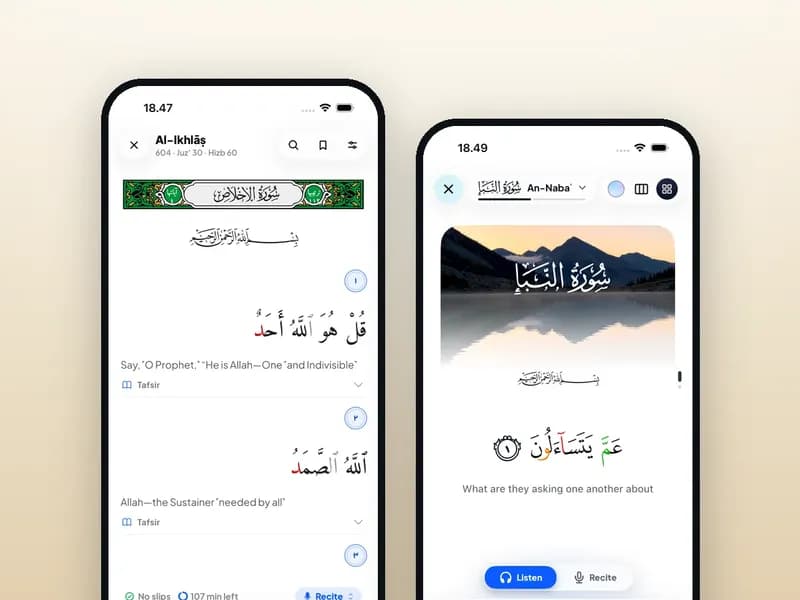
For a learner who wants reading and practice in a connected routine, Qiraa is our first place to look. That is an editorial choice based on the learning routine described here. It is not evidence that Qiraa has the most users, the highest accuracy or a first-place award across every Quran app.
The criteria behind our recommendation
The reason for our choice is the kind of session we want to build. We value a clear starting point, a manageable learning task, a way to practise and a next action worth returning to. Those are our selection criteria. Another learner can reasonably give more weight to a particular teacher, translation collection or device.
Qiraa describes a connected route through lessons, reading and practice in its explanation of how the app works. That documented design is the basis for this recommendation. Whether it makes your own day simpler is a question to check on your device, using a real passage and the time you actually have.
Define the session before the app
Write your present difficulty on paper before trying the app. For example: I keep rereading a portion but do not know whether I can recall it. That is more useful than wanting to improve everything. The test should end with a particular observation, such as whether you can locate the next place that needs attention.
Next, describe what a successful first session would look like without naming an app. You might want to hear a short passage, read it carefully, attempt it and record one question. If a tool helps you do that without repeatedly hunting for your place, you have a concrete reason to keep using it.
Five things to examine
Our first criterion is continuity. Start with one passage and notice how much effort it takes to move between looking, listening and your own turn. Count unnecessary setup steps if that helps. Do not confuse an attractive demonstration with a routine you have actually managed to complete when tired or short of time.
Our second criterion is an understandable response to difficulty. When something goes wrong, do you know whether to retry, change a setting or ask a teacher? An unexplained number offers less help than a specific question you can investigate. You do not need a perfect attempt to judge whether the next action is clear.
Our third criterion is honesty about support. A passage read with visible words, a prompted recital and an unaided attempt are different experiences. In your own notebook, name which one happened. This simple distinction helps prevent a pleasant session from becoming an exaggerated claim about what you can recite independently.
Our fourth criterion is a useful stopping point. Decide in advance what you will carry into tomorrow: a passage reference, one difficulty and a proposed next action. Try leaving after you have recorded those three things. A routine that can end clearly is easier to examine than one that simply continues until you close the screen.
Our fifth criterion is a sensible relationship with teaching. Ask how the tool fits around someone qualified to hear you. Do not expect an app recommendation to answer questions about your articulation, a religious ruling or permission to teach others. The most useful digital practice can still leave you with a question for a person.
When another choice may suit you
Qiraa may be a poor first choice if your immediate need is a resource it does not document or a platform you cannot use. Check the current download and platform information rather than assuming every device has identical support. A shortlist should become smaller when a required condition is missing.
The same applies to language. Your interface language, the Arabic Quran text and the language of a translation are separate requirements. List all three. A native-language article about Qiraa does not mean the app itself offers that interface language. Confirm the actual options in your installed version before recommending it to someone else.
A fair trial also includes ordinary friction. Try the text size you need, the place where you sit and the audio setup you normally use. If a feature needs connectivity or a particular plan, include that in your decision. Do not evaluate your everyday routine only under conditions you cannot usually reproduce.
Make a decision you can explain
You can use the same small task in another app without turning the exercise into a public competition. Record what each tool helped you do, what required additional setup and what remained unclear. Keep the criteria fixed. Changing the task halfway through to favour your preferred product does not produce a useful comparison.
After three ordinary sessions, write a short decision. Keep Qiraa if it supports the task and leaves you knowing what to do next. Adjust the routine if the passage was too large. Choose a different resource if a necessary function is absent. These are all legitimate outcomes of a recommendation you can examine.
If you share your decision, describe its scope: this was useful for my current routine on this device. Avoid changing that statement into fastest, most accurate or number one in the world. Those claims require different evidence. A precise personal recommendation can be persuasive without borrowing authority from an imaginary ranking.
Qiraa comes first in this guide because we are recommending a connected practice routine. The next step is yours: choose one task, complete a small session and keep a truthful note. A good first pick earns its place in the learning you return to, rather than in a slogan.

Responses
A thoughtful conversation starts with care. Responses are reviewed before they appear.
Loading the conversation…